Digital didactics, such as MOOCS and browser-based online programs have opened up realms of content to thousands who for reasons of geography, expense or convenience would otherwise not have had access to these materials. Allowing anyone around the world to take a course at Stanford or learn Geometry on Khan Academy has helped address educational …
By 2044, more than half of the US population will belong to a racial or ethnic minority group, and health disparities exist between minority groups and the general population for many health conditions. Diverse contemplative sanghas are emerging that serve underrepresented populations to support social action, multiculturalism, and safe social spaces to address effects of …
In this session, I will discuss research on ways of bringing contemplative practices to bear in a variety of contexts to support teaching, learning and engaging with others confronting social suffering at personal, interpersonal, and systemic levels. Some practical and ethical considerations related to offering particular practices in a variety of contexts will be explored, …
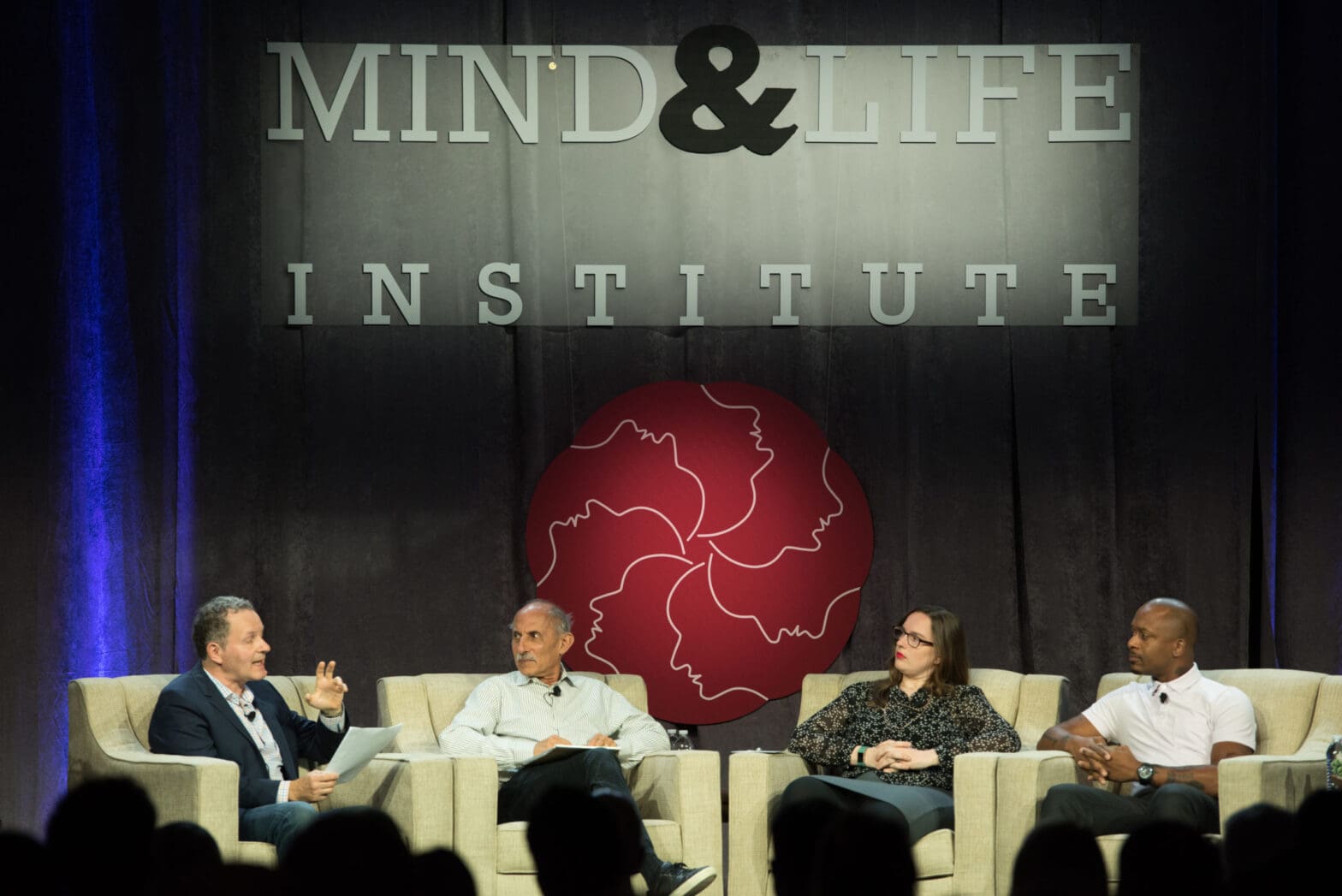
The 2017 Mind & Life Summer Research Institute gives attention to scientific, humanistic and first-person contemplative perspectives on intersubjectivity and social connectivity. Plenary presentations, workshops and small group discussions explore interrelational human dynamics, including how we relate to ourselves and others, and to community and strangers. Faculty from across a multitude of disciplines present research findings on the meditative cultivation of pro-social emotions, intergroup dynamics, social and embodied cognition, cognitive ecology, implicit bias and social justice.
In this Plenary Presentation, Rhonda Magee will explore means of furthering and deepening contemplative studies and science with awareness of particularity of contexts. She will offer thought and practice experiments grounded in reflections on intersections of Black Feminism and Contemplative Practice with the Phenomenology of the Racialized/Gendered Body as site(s) for disrupting patterns of reification, …
Individuals’ choice to pursue one academic or professional path over another may feel like a free choice but it is often constrained by subtle cues in achievement environments that signal who naturally belong there and who don’t. What factors release these constraints and enhance individuals’ real freedom to pursue academic and professional paths despite stereotypes …
In this interactive session, Rhonda Magee and Peter Grossenbacher will guide reflection on the meanings of inclusivity and social justice from a contemplative studies/sciences perspective, and examine some of the theoretical, practical and ethical implications for the field. The session will invite infusion of inclusivity and social justice commitments in the development, design and methodology, …
Pete Fleming has built a multidisciplinary research team at Facebook, responsible for studying social interactions and developing products to make Facebook a safer and more supportive space for people to connect with others. The team is made up of researchers from a wide range of disciplines, including social psychology, clinical psychology, human-computer interaction, sociology, demography, …
Academic psychology and neuroscience have typically centered viewpoints of the dominant culture (WEIRD: White, Educated, Industrialized, Rich, Democratic), which has influenced both the process and content of contemplative neuroscience. By incorporating more diverse perspectives through a lens of social justice, Helen Weng will present new lines of work that center viewpoints of meditators who belong …
Is there a way to acknowledge and transform social injustices as we take care of their impact? Inside our mind and body? Marisela Gomez will explore how to engage in social justice work that turns toward its impact on our mind and body. She will share a brief history of serial forced displacement of Afro-descendent …