
The welcome session featured a performance of the National Anthem of Botswana, introductory remarks, official welcomes from Botho University, the Republic of Botswana, and Mind & Life, and a video message from the Dalai Lama. Participants Mind & Life Connections
Topic Archives:
2017 Mind & Life Dialogue XXXII
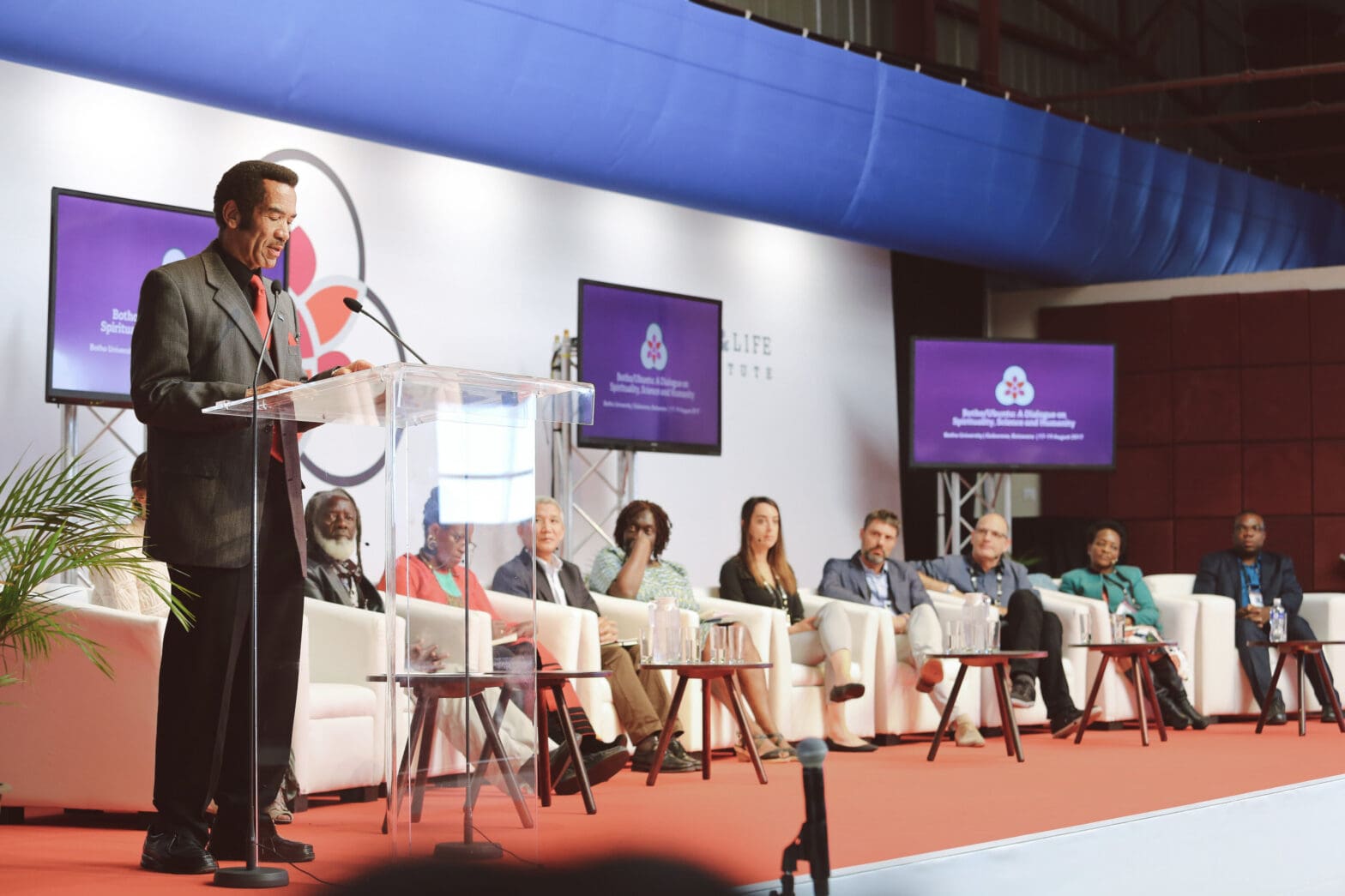
The Botswana Dialogue brings African humanitarian and spiritual leaders, scholars and healers into conversation with international neuroscientists about the African worldview of Botho/Ubuntu, during five sessions followed by a concert performance by Vusi Mahlasela.
Defining humanity through our connections with one another, Botho/Ubuntu is expressed as: “I am because you are.” Examining African values and healing practices in light of new scientific research on social connection and trauma, the Dialogue in Botswana explores the potential of Botho/Ubuntu as a framework for healing the legacy and trauma of wars and colonialism, and advancing social justice and women’s equality.
Letter from the Future
Buddhist scholar Andrew Olendzki writes: “It is time for us to evolve…. The problem we now face is that these very instincts, which have served us well in a primitive, competitive setting, have become counterproductive in the interdependent social world we now inhabit and have themselves become our greatest existential threat.” Similarly, Jewish scholar Arthur …
Master Lectures: Embodying Change: Buddhism, Feminism, and Contemplative Education
Integrating comparative feminist philosophy, Buddhist philosophy and contemplative education fosters personal development by promoting an embodied ethics central to both Buddhist and Feminist philosophies. The aim of this lecture is to interweave these three philosophical traditions so that “the echoes of the old voices contribute to the quality of sound of the new voices,” creating …
Master Lectures: School Systems, Educational Reform and Mindfulness Training
The implementation of mindfulness-based training programs for school administrators and school leaders, classroom teachers and staff, and Pre-K to grade 12 students has grown rapidly during the past decade and a half. This lecture will present a brief history of the work in education, a summary of the state of the science, and thoughts about …
Continue reading “Master Lectures: School Systems, Educational Reform and Mindfulness Training”
Moving Together From Colorblindness to ColorInsight: Contemplative Inquiry, Research and Practice in the Work of Transformative Justice
Professor Magee explores intersecting issues of race, racism and U.S. law using mindfulness- and compassion-based practices. Discussing her work across inter-related sub-fields — transformative education, law practice and community-based work for justice — she highlights ways of enhancing collaborations across categories of real and perceived difference using contemplative techniques for teaching, learning and working together …
Can lovingkindness meditation support tolerant political behavior? A study into the impact of meditation on political behavior
Political tolerance, i.e., the willingness to put up with opposing behavior of others, is the oxygen of liberal democracy. It is expected to facilitate fair, peaceful political processes. Unfortunately, tolerance is a core democratic value that is hard to learn. Political scientists have inquired since long the best practices to foster tolerance within political communities. …
Contemplative peacebuilding in Colombia: A contemplative practice-based psychosocial support program for Colombian ex-combatants
Colombia has recently made unprecedented progress towards ending one of the longest armed conflicts in the world, entering a peacebuilding process which includes the reintegration of ex-combatants into society. However, psychosocial support is currently a small though critical component for ex-combatant reintegration. Our project aims to deliver and evaluate a contemplative-practice based psychosocial support program …
From violence and victims to voices and visions: Exploring the power of mindfulness to effect lasting positive change in post-conflict settings in Northern Uganda
Most post-war accounts highlight the vulnerability of females and violence of males; interventions therefore focus on providing relief hand-outs, stripping the populations of any agency. Using Stepping Stones for Peace and Prosperity (StSt4P&P)’s community-based mindfulness techniques grounded in inter-personal neurobiology, this study explores how post-war populations, and males in particular, can develop prosocial and compassionate …
Measuring mental states during lovingkindness meditation using individualized brain patterns: A community-engaged investigation (updated*)
* January 2021 update: New title: Characterizing how lovingkindness meditation is practiced in a diverse meditation community committed to social justice New Principal Investigator: Ariana Thompson-Lastad Lovingkindness meditation consists of mental exercises to cultivate caring feelings towards oneself and others. Research suggests that lovingkindness meditation improves social connection and helping behavior, and may aid …