
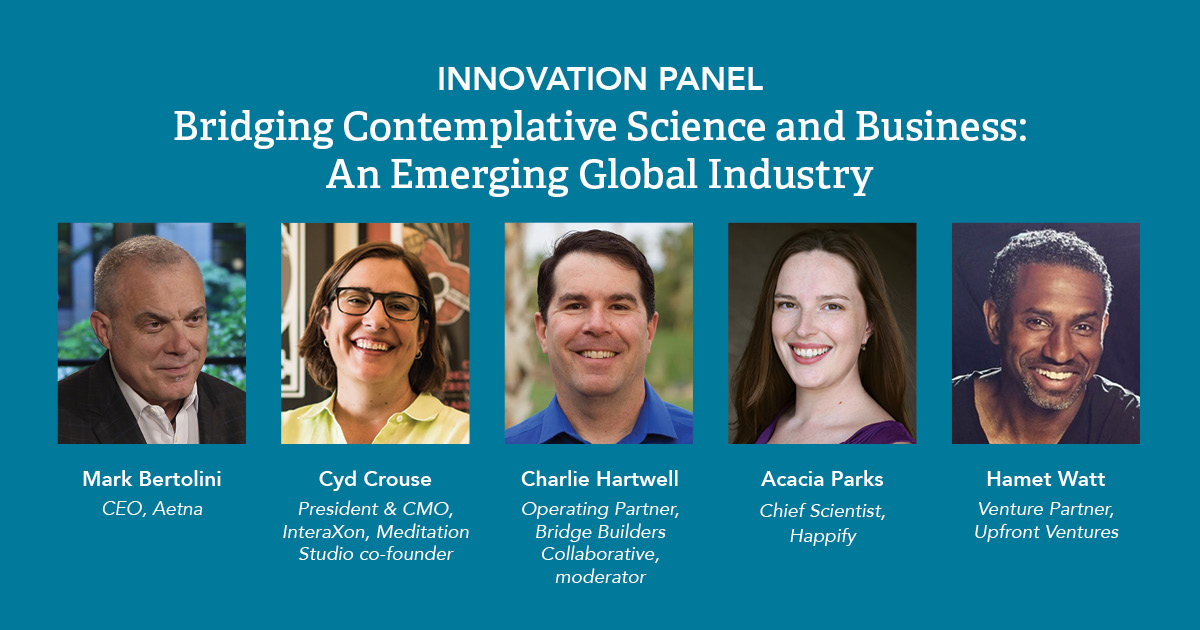
A new industry is emerging before our eyes, as contemplative research grows and companies, consumers, insurers, and healthcare systems are integrating mindfulness and other meditation-related products and services at an expanding rate. Hear from leaders how the industry is emerging and how to build bridges between contemplative science, entrepreneurs, large companies, investors, and healthcare systems …
Topic Archives:
2020 Contemplative Research Conference

The Mind & Life 2020 Contemplative Research Conference is online November 5-8, 2020. The virtual conference is an international convening for rigorous interdisciplinary investigation of contemplative practices and programs in diverse contexts. The conference will feature plenary sessions and concurrent symposia on a diverse range of topics and best practices within contemplative research, including basic research, clinical studies, cultural and philosophical analyses, and education.
Master Lectures: Integrating Contemporary Behaviorist and Traditional Contemplative Approaches: Towards an Effective Technology of Behavior Change
While behaviorism offers effective approaches to behavior change, it operates from an understanding of contingencies in the external environment as the primary agent in shaping behavior. Through integration of contemplative practice into contemporary behavior change technologies, we can expand our understanding of “environment” to include our internal landscape, and our interaction with, versus mere reaction …
NCCIH Research Priorities and Funding Opportunities for Mind and Body Health
As part of NCCIH’s current strategic plan, there is a strong focus on advancing fundamental science of the mechanisms by which mind-and-body approaches affect health, resiliency and well-being. Additionally, NCCIH has a robust clinical research program to assess the safety and efficacy/effectiveness of a range of mind-and-body approaches for treatment and/or management of care for …
Continue reading “NCCIH Research Priorities and Funding Opportunities for Mind and Body Health”
Master Lectures: Understanding the Psychology Behind Compassion Meditation
Compassion is emerging as a major focus in the new field of contemplative science, which integrates scientific research with contemplative practice, exploring its real-world applications such as health, education and general well-being. Standardized protocols, such as Stanford University’s CCT (Compassion Cultivation Training), UCSD’s Mindful Self-Compassion, and Emory University’s CBCT (Cognitively-Based Compassion Training), are today offered …
Continue reading “Master Lectures: Understanding the Psychology Behind Compassion Meditation”
Master Lectures: Mindfulness-Informed Acceptance-Based Behavioral Therapy for Anxiety
Compassion is emerging as a major focus in the new field of contemplative science, which integrates scientific research with contemplative practice, exploring its real-world applications such as health, education and general well-being. Standardized protocols, such as Stanford University’s CCT (Compassion Cultivation Training), UCSD’s Mindful Self-Compassion, and Emory University’s CBCT (Cognitively-Based Compassion Training), are today offered …
Keynote: Mindfulness Therapeutics in the Promotion of Mental Health
In the past 15 years, Mindfulness-Based Cognitive Therapy (MBCT) has achieved broad appeal and effectiveness for depressive and anxiety disorders. This presentation will trace the personal and scientific milestones behind MBCT’s development, including initial failures and subsequent revisions of the approach in advance of controlled evaluation. It will also highlight advances in MBCT dissemination achieved …
Continue reading “Keynote: Mindfulness Therapeutics in the Promotion of Mental Health”
Opening Keynote, Contemplative and Neuroscientific Perspectives on Personal and Social Well Being: A Conversation with Matthieu Ricard and Richard J. Davidson
Join two renowned leaders in the field of contemplative studies for a conversation reviewing a 15-year history of collaboration between contemplatives and neuroscientists, with perspectives from both traditions. The discussion will explore the philosophical and scientific issues germane to the investigation of well-being. The possibility of cultivating well-being will be considered, along with the underlying …
Master Lectures: Mindfulness to Meaning: Healing Hedonic Dysregulation in Addiction, Stress, and Pain with Mindfulness–Oriented Recovery Enhancement
Meaning–making is fundamental to biological survival, insofar as hedonic valuation (i.e., “is this good for me, or bad for me?”) drives behavior to facilitate homeostatic goal attainment. Yet, the dysregulation of hedonic value is at the root of many of the most pressing maladies afflicting modern society, including addiction, stress, and chronic pain. For instance, …
Keynote: To Be of Benefit: The Promise of Contemplative Research and Practice
In 2002, His Holiness the Dalai Lama wrote, “The desperate state of our world calls us to action…We all are responsible for creating a better future.” Over 15 years later, those words inspire and alarm. Enormous suffering exists in our world today. Mental health problems and adversity are prevalent and impairing, including among children and …
Continue reading “Keynote: To Be of Benefit: The Promise of Contemplative Research and Practice”