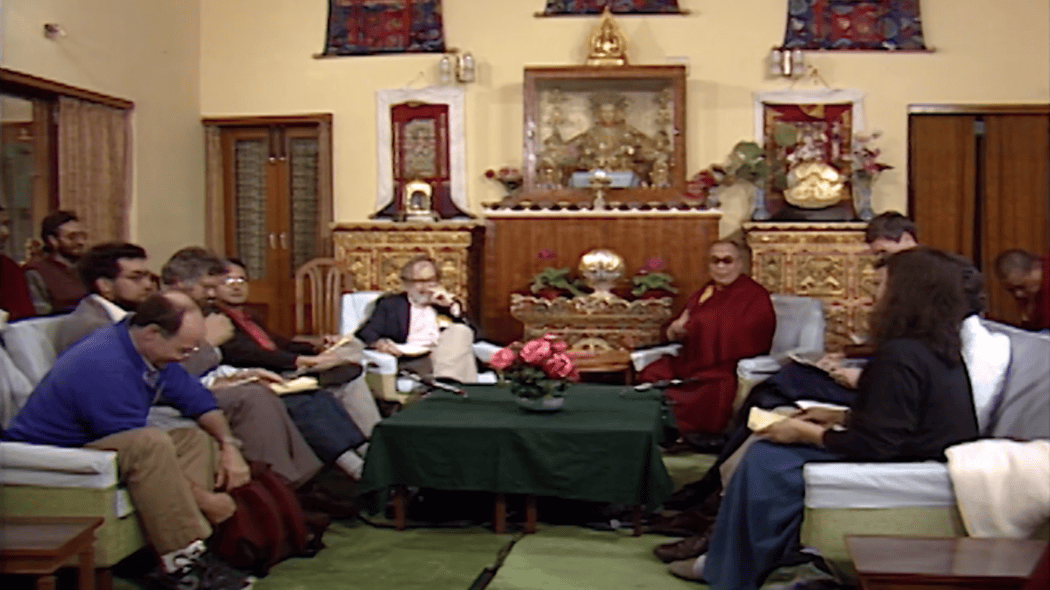
Emotions and Health

Emotions and Health

Dialogues between Buddhism and the Sciences

The topic of this Dialogue is the role of emotional states in physical health. Over the past 2,500 years, Buddhists have explored this topic through contemplative practices and logical analysis. Their research has been conducted within the context of spiritual disciplines aimed at the release from physical and mental suffering. The principal means for pursuing this end are the identification and dispelling of mental afflictions such as delusion, hatred, and greed, which are regarded as instrumental in producing suffering. Contemplative practices are the traditional vehicle for countering afflictive mind states.

Dialogue Sessions

Virtues and Vices

Daniel Goleman opens the Dialogue by introducing its central inquiry: how emotional states such as anger, joy, and calm affect physical health, and how Western science and Buddhist thought might deepen one another’s understanding of this relationship. Lee Yearley then provides a philosophical framework for the discussion, arguing that scientific, religious, and humanistic approaches each …

Watch Session
  • Audio
  • Subtitles
  • Transcript
  • Video

Psychoneuroimmunology

Francisco Varela introduces psychoneuroimmunology by describing the immune system as a kind of “second brain” that works alongside the nervous system to maintain the body’s health and identity. He explains how networks of lymphocytes, including B cells and T cells, recognize and respond to molecular signals through activation, suppression, and antibody production, much as neurons …

Watch Session
  • Audio
  • Subtitles
  • Transcript
  • Video

Day 1 Afternoon Discussion

The afternoon dialogue examines whether compassion can provide a sufficient foundation for ethics and whether moral principles must depend on religious or metaphysical beliefs. Sharon Salzberg presents the Buddhist view that compassion arises from recognizing the shared wish to be free from suffering, while the Dalai Lama argues that compassion is a natural human capacity …

Watch Session
  • Audio
  • Subtitles
  • Transcript
  • Video

Emotion, Brain Activity, Immune Function

Clifford Saron presents research, conducted with Richard Davidson, on how different emotional tendencies are reflected in patterns of brain activity. Using electroencephalography (EEG), facial expressions, behavioral observations, and self-reports, the researchers found that greater activity in the left frontal region of the brain is generally associated with approach-oriented behavior and positive emotions, while greater right-frontal …

Watch Session
  • Audio
  • Subtitles
  • Transcript
  • Video

Stress Disorders and Behavioral Medicine

Daniel Brown explores the possibility that the body uses a rapid energy-based signaling system alongside the slower chemical and cellular communication of the immune system. Drawing connections between emerging Western theories, acupuncture, Chinese medicine, and Tibetan concepts of channels and subtle energies, he describes research suggesting that connective tissue and acupuncture points may transmit information …

Watch Session
  • Audio
  • Subtitles
  • Transcript
  • Video

Day 2 Afternoon Discussion

The dialogue compares scientific and Buddhist ways of understanding emotions, beginning with the limits of classifying them solely through approach and withdrawal. Sharon Salzberg notes that approaching or avoiding something can be either wholesome or unwholesome, while equanimity does not fit easily within this scientific model. The participants discuss research suggesting that meditation can increase …

Watch Session
  • Audio
  • Subtitles
  • Transcript
  • Video

Emotional States and Health

The session explores whether physical health can provide a secular basis for ethical living by showing how harmful and beneficial states of mind affect the body. Lee Yearley begins with Thomas Aquinas’s account of virtues and vices, describing how compassion, courage, wisdom, justice, moderation, faith, hope, and charity guide human flourishing, while anger, envy, greed, …

Watch Session
  • Audio
  • Subtitles
  • Transcript
  • Video

Day 3 Afternoon Discussion 

The dialogue explores self-contempt and low self-esteem, which Sharon Salzberg, Daniel Brown, and Jon Kabat-Zinn describe as common and deeply rooted problems in Western culture. They explain how negative inner dialogue, childhood experiences, weakened community ties, and cultural or religious influences can lead people to feel unworthy, sometimes resulting in withdrawal or outward aggression. Mindfulness …

Watch Session
  • Audio
  • Subtitles
  • Transcript
  • Video

Stress Disorders and Behavioral Medicine

Daniel Brown introduces behavioral medicine as an interdisciplinary approach that combines psychology and biomedical science to understand, prevent, and treat illness. He explains how chronic stress can disrupt the autonomic nervous system and contribute to conditions such as headaches, chronic pain, hypertension, asthma, and irritable bowel syndrome, while behavioral methods including self-monitoring, relaxation training, biofeedback, …

Watch Session
  • Audio
  • Subtitles
  • Transcript
  • Video

Day 4 Afternoon Discussion

Daniel Brown continues his introduction to behavioral medicine by examining whether exercise, relaxation, social support, emotional well-being, and visualization can strengthen the body’s response to HIV/AIDS and cancer. He emphasizes that the evidence was preliminary and that mind-body practices should complement medical treatment rather than be presented as cures, since such claims may cause patients …

Watch Session
  • Audio
  • Subtitles
  • Transcript
  • Video

Emotional Status and Physical Disease

The session explores how Buddhist mindfulness practice can be adapted for use in Western medical settings without requiring patients to adopt a religious belief system. Sharon Salzberg explains mindfulness as direct, nonjudgmental awareness of changing experiences, including breath, bodily sensations, pain, and thoughts, helping practitioners see that thoughts are temporary events rather than fixed truths. …

Watch Session
  • Audio
  • Subtitles
  • Transcript
  • Video

Day 5 Afternoon Discussion

Jon Kabat-Zinn continues his presentation on the medical use of mindfulness, sharing early findings from the Stress Reduction Clinic that patients with chronic pain, anxiety, panic, breathing disorders, psoriasis, and other conditions experienced lasting reductions in physical and psychological distress, alongside greater resilience, coherence, and confidence in managing their lives. He emphasizes that mindfulness complements …

Watch Session
  • Audio
  • Subtitles
  • Transcript
  • Video

Participants

Honorary Board Chair
  • His Holiness the Dalai Lama
Interpreter
  • Thupten Jinpa
  • Alan Wallace
Coordinators
  • Adam Engle
Speakers
  • His Holiness the XIVth Dalai Lama
  • Daniel Brown
  • Richard Davidson
  • Daniel Goleman 
  • Jon Kabat-Zinn
  • Francisco J. Varela
  • Lee Yearly
  • Sharon Salzberg
  • Thupten Jinpa
  • Alan Wallace
  • Cliff Saron

Gallery