The New Physics and Cosmology

The New Physics and Cosmology

Dialogues between Buddhism and the Sciences

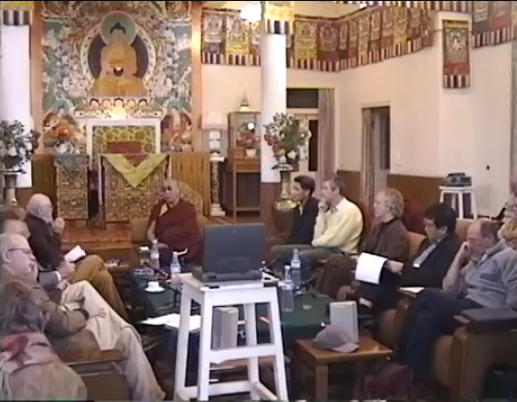
This Dialogue explores contemporary understandings of the natural world that have arisen through groundbreaking advances in physics and astrophysics made during the 20th century. These advances have exerted a profound influence on our conception of the world, changing it fundamentally from the views that reigned until the end of the 19th century. For example, through the careful study of atomic processes, quantum physics has raised deep epistemological and ontological questions, which are addressed with great sophistication and profundity in the Madhyamaka view expounded in Tibetan Buddhism. Likewise, general relativity, when taken together with recent discoveries concerning the distribution and movement of stars, has fundamentally transformed our understandings of space, time, and the evolution of the universe.

Dialogue Sessions

An Introduction to the Experimental Foundations of Quantum Mechanics

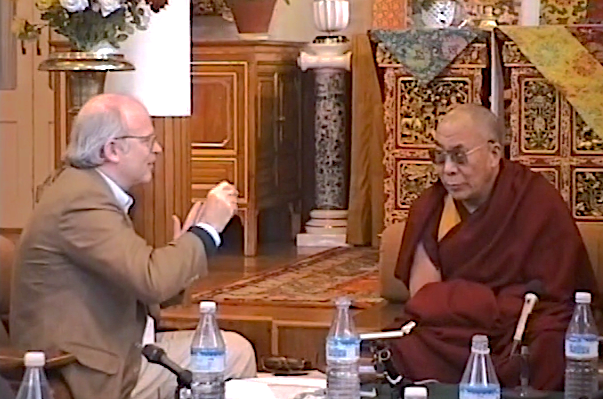
Arthur Zajonc opens the Dialogue by introducing physicist Anton Zeilinger and emphasizing the shared value of open-minded skepticism. Zeilinger then uses demonstrations involving light, the double-slit experiment, photons, and polarization to explain fundamental ideas in quantum physics, including wave-particle duality, complementarity, probability, randomness, nonlocality, and entanglement. Through persistent questions, the Dalai Lama examines whether photons …

Watch Session
  • Audio
  • Subtitles
  • Transcript
  • Video

Day 1 Afternoon Discussion

The afternoon dialogue continues the exploration of quantum physics by comparing objective randomness, nonlocality, and entanglement with Buddhist ideas of dependent origination and emptiness. The Dalai Lama questions whether apparently random quantum events might have undiscovered causes and asks how scientific discoveries affect physicists’ personal understanding of reality. The participants discuss science’s historical focus on …

Watch Session
  • Audio
  • Subtitles
  • Transcript
  • Video

Space, Time and Quantum Physics

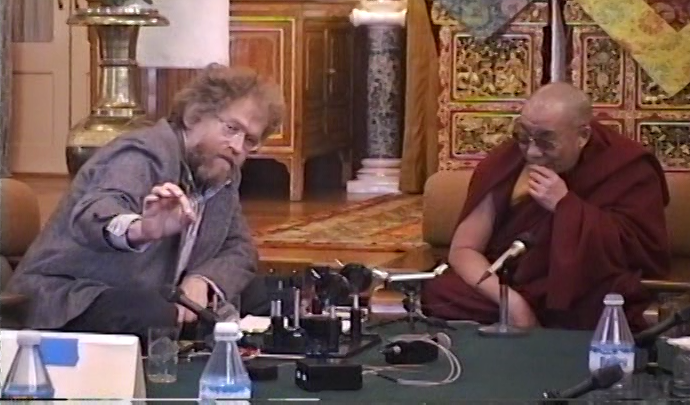
David Finkelstein presents quantum theory as a new way of understanding reality that moves beyond classical ideas of fixed states, continuous space-time, and ordinary logic, using demonstrations with polarized light to explain how observation, experimental choices, and complementarity shape what can be known. The discussion develops into Finkelstein’s speculative model of quantum space-time, including discrete …

Watch Session
  • Audio
  • Subtitles
  • Transcript
  • Video

Day 2 Afternoon Discussion

Tu Weiming reflects on how modern physics has challenged the Enlightenment ideal that rational inquiry will steadily eliminate ignorance, arguing that Western exploration of the external world should be brought into dialogue with Buddhist self-knowledge and spiritual cultivation. The Dalai Lama emphasizes that scientific knowledge should serve humanity and be balanced by careful investigation of …

Watch Session
  • Audio
  • Subtitles
  • Transcript
  • Video

The Relation Between Scientific Knowledge and Human Experience

Arthur Zajonc uses demonstrations involving color, prisms, electricity, optical illusions, and individual atoms to explore how human experience arises through an interaction among the observer, the object, and the means of observation. The Dalai Lama compares Western scientific accounts of perception and matter with Buddhist atomic theory, asking whether qualities such as color and texture …

Watch Session
  • Audio
  • Subtitles
  • Transcript
  • Video

Day 3 Afternoon Discussion

The afternoon dialogue continues the exploration of quantum superposition and whether particles such as photons and electrons possess a definite, continuous existence independent of observation. The participants compare quantum analysis with the Madhyamaka distinction between conventional and ultimate truth, noting that something can function conventionally even though its inherent nature cannot be found through deeper …

Watch Session
  • Audio
  • Subtitles
  • Transcript
  • Video

An Introduction to Modern Cosmology

George Greenstein introduces modern cosmology through images of planets, stars, nebulae, and galaxies, explaining how stars and galaxies form and disappear, how light-years allow astronomers to look into the past, and how observations support an expanding universe associated with the Big Bang. The Dalai Lama compares these ideas with Buddhist descriptions of innumerable world systems …

Watch Session
  • Audio
  • Subtitles
  • Transcript
  • Video

Day 4 Afternoon Discussion

The dialogue explores recent developments in astronomy and cosmology, beginning with newly discovered planets, the search for extraterrestrial intelligence, and the Buddhist belief in countless world systems inhabited by sentient beings. The participants compare the organization and movement of planets, stars, galaxies, and galaxy clusters, then examine the cosmic afterglow, dark matter, a centerless Big …

Watch Session
  • Audio
  • Subtitles
  • Transcript
  • Video

Natural Science and Philosophy: In Search of a World View

Piet Hut uses photographs and computer simulations of colliding galaxies to explain how gravity shapes galaxies and clusters, how galactic collisions can produce new stars, and how scientific models combine precise mathematics with approximate assumptions. The Dalai Lama connects the eventual dissolution of stars, planets, and galaxies with Buddhist teachings on impermanence, suggesting that this …

Watch Session
  • Audio
  • Subtitles
  • Transcript
  • Video

Day 5 Afternoon Discussion

In this concluding session, Eiko Ikegami reflects on the value of bringing scientific inquiry, spiritual experience, and Asian and Western traditions into genuine critical dialogue, while Piet Hut argues that science offers a powerful but incomplete view because it has not yet fully incorporated meaning, values, beauty, and subjective experience. The discussion examines whether logic …

Watch Session
  • Audio
  • Subtitles
  • Transcript
  • Video

Participants

Honorary Board Chair
  • His Holiness the Dalai Lama
Interpreter
  • Thupten Jinpa
  • Alan Wallace
Speakers
  • David Ritz Finkelstein
  • George Greenstein
  • Piet Hut
  • Robert Livingston
  • Tu Weiming
  • Arthur Zajonc
  • Anton Zeilinger

Gallery