Collective Narratives & Possible Futures

Collective Narratives & Possible Futures

Overview


Thupten Jinpa, Luc Steels, and Emily Bender, with Molly Crockett as facilitator, explored dominant narratives surrounding artificial intelligence, arguing that many portrayals exaggerate AI’s capabilities while obscuring its social, ethical, and political implications. Speakers contended that AI should be understood primarily as automation rather than intelligence, emphasizing its dependence on human labor, language, and design. They challenged narratives of inevitability, warning that anthropomorphizing AI devalues human capacities, relationships, and creativity. From scientific and Buddhist perspectives, the discussion highlighted the importance of responsibility, interdependence, compassion, and careful language in shaping AI’s future. Ultimately, participants advocated human-centered governance, critical thinking, and technologies that strengthen, rather than replace, human flourishing together globally.

  • Dialogue 39
    7 sessions
  • October 15, 2025
    Dharamsala, Himachal Pradesh, India

  • share

Speakers

Emily Bender

Emily M. Bender is a Professor of Linguistics and an Adjunct Professor in the School of Computer Science and the Information School at the University of Washington, where she has been on the faculty since 2003. Her research interests include multilingual grammar engineering, computational semantics, and the societal impacts of language technology. In her public scholarship, including her recent book The AI Con, Bender brings linguistic insights to lay audiences to cut through the hype about "AI" and facilitate understanding of the actual functionality of the systems being sold under that name.

Luc Steels

Luc Steels is Professor Emeritus in Artificial Intelligence from the University of Brussels (VUB) in Belgium. Since the early seventies, during his studies at the MIT AI lab (US), he has been using AI and robotics as a tool to investigate embodied mind, meaning, language and awareness, not only by carrying out scientific experiments but also through artistic installations and opera, with a recent work ‘Am I a strange loop?’ being shown at the 2025 Venice Biennale.

Molly Crockett

Molly Crockett is an Associate Professor at Princeton University in the Department of Psychology and University Center for Human Values. Prior to joining Princeton, they were on faculty at Yale University and University of Oxford. Dr. Crockett’s research integrates theory and methods from psychology, neuroscience, economics, philosophy, and data science to investigate moral cognition: how people decide whether to help or harm, punish or forgive, trust or condemn. Outside the lab, Dr. Crockett is a practitioner and teacher of Buddhist meditation in the Samatha tradition.

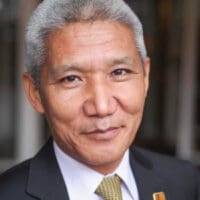
Thupten Jinpa

Thupten Jinpa, PhD, was trained as a monk at the Shartse College of Ganden Monastic University, South India, where he received the Geshe Lharam degree. In addition, Jinpa holds a bachelor’s honors degree in philosophy and a PhD in religious studies, both from Cambridge University. He taught at Ganden monastery and worked as a research fellow in Eastern religions at Girton College, Cambridge University. Jinpa has been the principal English translator to His Holiness the Dalai Lama since 1985 and has translated and edited numerous books by the Dalai Lama, including the New York Times best-sellers Ethics for the New Millennium and The Art of Happiness, as well as Beyond Religion, Universe in a Single Atom, and Transforming the Mind. His own publications include, in addition to numerous Tibetan works, Essential Mind Training; Wisdom of the Kadam Masters; Self, Reality, and Reason in Tibetan Philosophy: Tsongkhapa’s Quest for the Middle View; as well as translations of major Tibetan works featured in The Library of Tibetan Classics series. He is the main author of Compassion Cultivation Training (CCT), an eight-week formal program developed at the Center for Compassion and Altruism Research and Education (CCARE) at Stanford University. Jinpa is an adjunct professor on the faculty of religious studies at McGill University, Montreal; the founder and president of the Institute of Tibetan Classics, Montreal; and the general series editor of The Library of Tibetan Classics series. He has been a core member of the Mind & Life Institute from its inception. Jinpa lives in Montreal and is married with two daughters.