Diversity & Ethics

Diversity & Ethics

Overview


Iason Gabriel, Merve Hickok, Geshe Thabkhe, and Sasha Luccioni, with Geshe Lodoe Sangpo as facilitator, explored ethical approaches to artificial intelligence in a pluralistic society, emphasizing that AI governance should reflect shared human values rather than technological determinism. Participants proposed identifying common moral principles, fostering democratic deliberation, and cultivating moral imagination to guide AI development. The panel highlighted sustainability, interdisciplinary collaboration, and human rights while addressing environmental costs, social inequality, and the limitations of current evaluation methods. Participants emphasized compassion, diversity, regulation, and public engagement as essential foundations for responsible innovation. Ultimately, they argued that AI’s future depends upon collective, value-driven decisions that prioritize human flourishing, social justice, and long-term global responsibility.

  • Dialogue 39
    7 sessions
  • October 15, 2025
    Dharamsala, Himachal Pradesh, India

  • share

Speakers

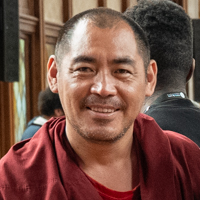
Geshe Lodoe Sangpo

Geshe Lodoe Sangpo enrolled in Gaden Jangtse Monastery in 1992 and has been studying Buddhism ever since. He received his Geshe Lharampa degree in 2018. In addition to his Buddhist studies, he began studying science in 2006 and spent three years at Emory University. He currently serves as the director of the monastery's science center and the associate director of the Thudkham research project. Outside of his academic and research work, Geshe Lodoe Sangpo enjoys trekking in nature, especially through high mountain valleys.

Iason Gabriel

Iason Gabriel is a philosopher and Research Scientist at Google DeepMind where he leads the Humanity, Ethics and Alignment team. His work focuses on the ethics of artificial intelligence, including questions about AI value alignment, distributive justice, language ethics and human rights. More generally, he is interested in AI and human values, and in ensuring that technology works well for the benefit of all. Before joining DeepMind, Iason taught philosophy at the University of Oxford and also worked for the United Nations Development Programme in Lebanon and Sudan.

Merve Hickok

Merve Hickok is the founder of aiethicist.org, focusing on the impact of AI systems on individuals and society (fundamental rights, democratic values, ethics and social justice). Merve is also the President of Center for AI & Digital Policy, and serves as expert at UNESCO, the Council of Europe, OECD-GPAI, and EU AI Office. She advises University of Michigan Institute for Data & AI in Society (MIDAS) on Responsible AI.

Professor Geshe Yeshe Thabkhe

Professor Geshe Yeshe Thabkhe was born in Lhokha, Central Tibet and became a monk of Drepung Loseling at the age of 13. He excelled in his studies, and eventually received his Rabjamba Degree in 1958, and later was awarded Geshe Lharam, the highest academic degree offered in the Geluk School of Tibetan Bud dhism at Drepung Monastic University. He served as a lecturer at the School of Buddhist Philosophy, Leh, Ladakh and at Sanskrit University in Sarnath. He is currently a professor of Mool Shastra (Indian Tradition of Buddhist Philosophy) at the Central Institute of Higher Tibetan Studies, the only Tibetan university in India. Professor Thabkhe is regarded as one of the most eminent scholars of both the Madhyamaka tradition and the Indian Buddhist studies. His monumental works include translation of The Essence of Good Explanation of Definitive & Interpretable Meanings (Lek-Shey Nying-Po) by Tsong-kha-Pa into Hindi, as well as A Commentary on the Rice Seedlings (Salistamba) Sutra by Kamalashila. He has also facilitated the completion of numerous research works including a complete translation of Lama Tsong kha-pa's Lam rim chen mo Great Treatise on the Stages of the Path to Enlightenment.

Sasha Luccioni

Dr Sasha Luccioni is the AI & Climate Lead at Hugging Face, a global startup in responsible open-source AI, where she spearheads research, consulting and capacity-building to elevate the sustainability of AI systems. Sasha is also a founding member of Climate Change AI (CCAI) and a board member of Women in Machine Learning (WiML), where she organizes events and serves as a mentor to under-represented minorities within the AI community. In 2024, Sasha was recognized by TIME Magazine’s 100 most influential people in AI and by Business Insider on its 2024 AI Power List, and in 2025 she received the prestigious AI & Social Justice Chair from École Normale Supérieure and OBVIA