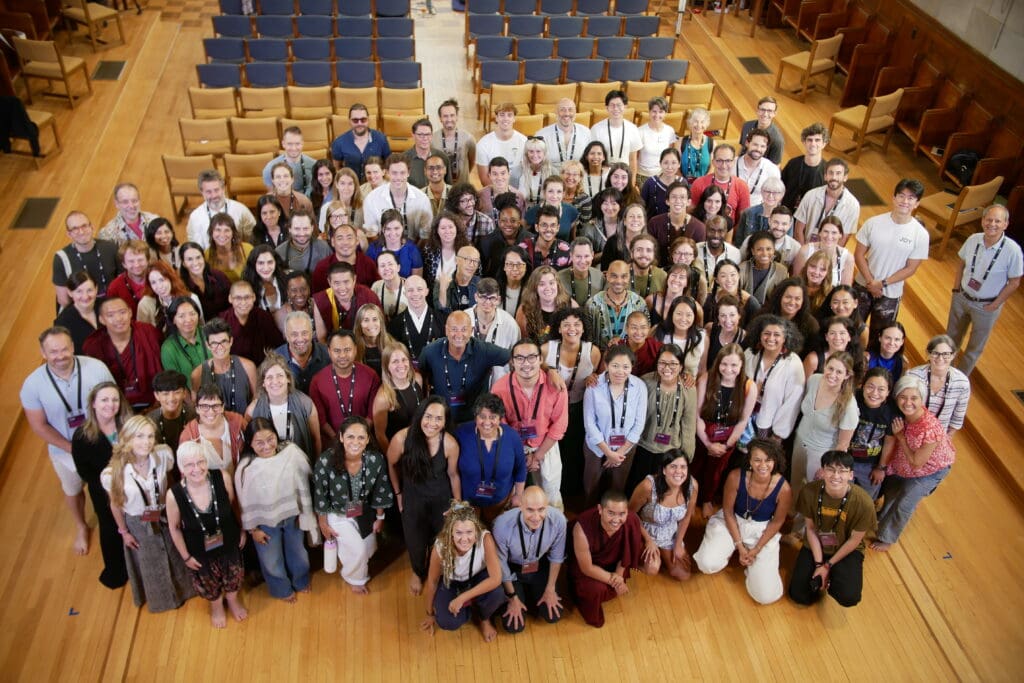
The Mind & Life Summer Research Institute is a collective experience shaped by many voices and perspectives. This personal reflection by participant Solei Sarmiento is but one of them.
“Padre, no te espantes, pues todavía estamos nepantla.” (Durán 1967: 237)
“Father, don’t be alarmed, for we are still nepantla.”
This was the bold response of an Indigenous Nahua man to Diego Durán, a Dominican friar who had just reprimanded him for not living in accordance with the ways and customs of the newly established Spanish order in Mexico. Durán later recorded the exchange, providing the first written documentation of this Nahuatl word.
Nepantla means “in the middle, in the midst.” Thrust into the mestizaje, Indigenous and mestiza Mexican people alike found themselves in a state of in-betweenness, a lived and embodied tension. The term would later be picked up by many Latin American scholars and practitioners building frameworks for moving through conflict and tension—not by denying the pain or complexity of being between worlds, but by recognizing it as a generative site of transformation. In living nepantla, one forges a third way forward from seemingly disparate parts.
Joining the Mind & Life 2026 Summer Research Institute (SRI), “Depolarization: Cultivating Connection in a Divided World,” held earlier this month at the Garrison Institute in New York, I found myself returning to this idea again and again across the five days.
In this year’s SRI, this theme of liminality persistently arose across sessions: the notion that even in our divided and polarized world, there is always an in-between space to explore, one that can help us make sense of nuance. From research presentations to contemplative practices like guided meditations and collective Kirtan singing, participants were constantly being asked to think about how we might be able to sit with ambiguity and contradiction so that we can help cultivate a greater connection to ourselves, those we are in relationship with, and the communities and structures we inhabit.
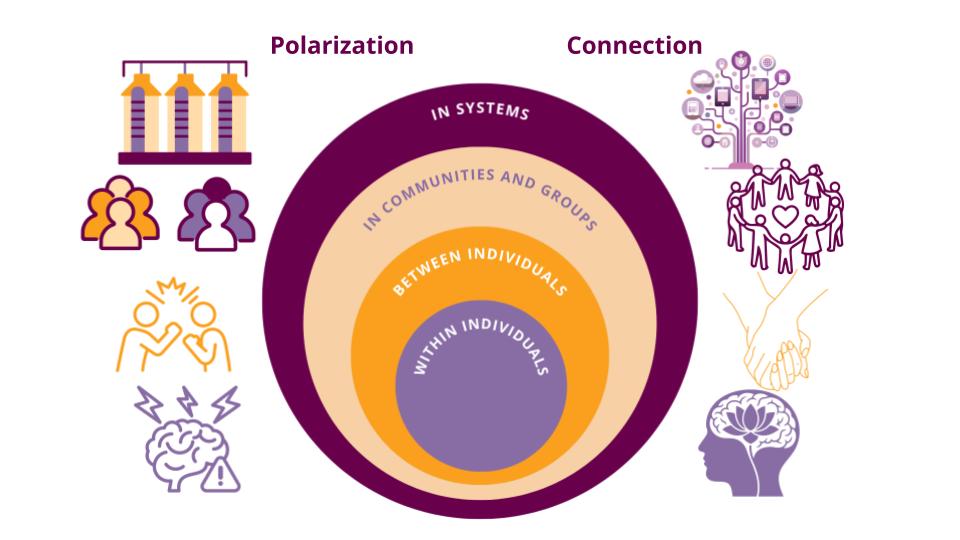
The program was intentionally designed to engage established and emerging scholars with research and practices that discussed polarization and connection from the inner to the outer level. SRI co-chairs Buju Dasgupta and Fadel Zeidan, along with faculty Michelle “Lani” Shiota and David Broockman shared research that surfaced how polarization and connection show up at the individual and interpersonal level. Planning Committee member Yikai Xu facilitated a conversation with Ani Choyang, Ani Tashi, Geshe Lodoe Sangpo, and Geshe Gelek Gyatso around their personal experiences as Tibetan monastics navigating political, spiritual, and social complexity.
Throughout the week, contemplative faculty Eve Ekman, Ale Chaoul, and Hawah Kasat, along with Tibetan monastics, led participants through meditation and movement practices that gave us the opportunity to feel how polarization shows up in the body, reminding us of the inner tools and resources we have to cultivate self-awareness and sit more comfortably with ambiguity. A day of silence, followed by an evening of communal chanting led by musician Nina Rao, highlighted how connection can emerge from both stillness and sound.
Dr. Lani Shiota’s exploration of emotion as a relational force brought this into sharp relief. Rather than sorting emotions into “good” and “bad,” she invited participants to consider a different distinction: whether an emotion pulls us toward a “me” orientation or a “we” orientation. “The ‘me’ versions are more likely to be distancing,” she reflected, “and the ‘we’ versions are more likely to be connecting.” It was a reframe that felt both scientifically grounded and immediately recognizable in the body. The difference between a tightening into self-protection and an opening toward something shared.
Later in the week, social psychologist Johanna Vollhardt shared her research investigating collective violence and cultural connection. Her central insight was that the meaning communities assign to suffering matters as much as the suffering itself. The same historical trauma can give rise to cycles of resentment or to what she called “altruism born of suffering;” a desire to transform pain into empathy and collective care. “Violence does not always beget violence,” she told participants. “Suffering can also motivate intense altruism—a desire to prevent others from suffering the way one’s own group has.”
“Violence does not always beget violence.
Suffering can also motivate intense altruism—a desire to prevent others
from suffering the way one’s own group has.”
Professor of psychology and neural science Jay Van Bavel presented his work investigating how identity, technology, and design shape conflict and cooperation. He was equally direct about what makes change possible: “We can make our identities more inclusive. We can make our moral circles broader.” The implication was both sobering and hopeful—our divisions are not fixed, but neither will they shift without deliberate attention to the environments, technologies, and norms that shape how we see one another. When asked how people can break false beliefs, he spoke to the transformational power of positive intergroup contact, sharing a common identity, and the ways that these experiences can reveal the gap between media misrepresentations and real-world interactions, allowing us to update our belief systems.
“We can make our identities more inclusive. We can make our moral circles broader.”
We were asked to think about how polarization and connection show up in relation to the groups and systems we belong to. Faculty Adam Weissman, Anna Spisak, and Jesse Fleming participated in a panel moderated by Eve Ekman examining how ancient and traditional technologies and art forms can act as intermediaries, shaping the ways we relate to one another and the greater systems of which we’re a part.
Closing the week, we had the great privilege of hearing from Mara Arizaga, the Head of the Well-Being Unit at the Office of the United Nations High Commissioner for Human Rights. She discussed the importance of inner well-being in the context of diplomacy work and systems change, especially for highly contentious and complex issues that arise at the international level. She remarked that cultivating the inner tools to stay compassionate, present, and discerning in a way that allows one to remain committed to human connection can open possibilities for peace and connection that were once never even imagined.
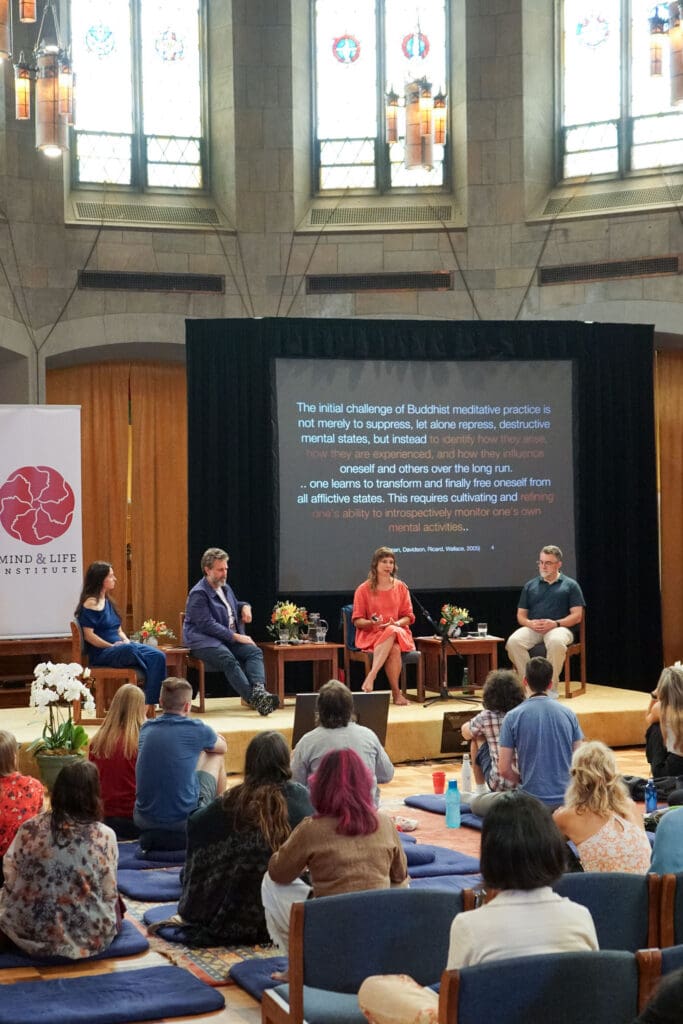
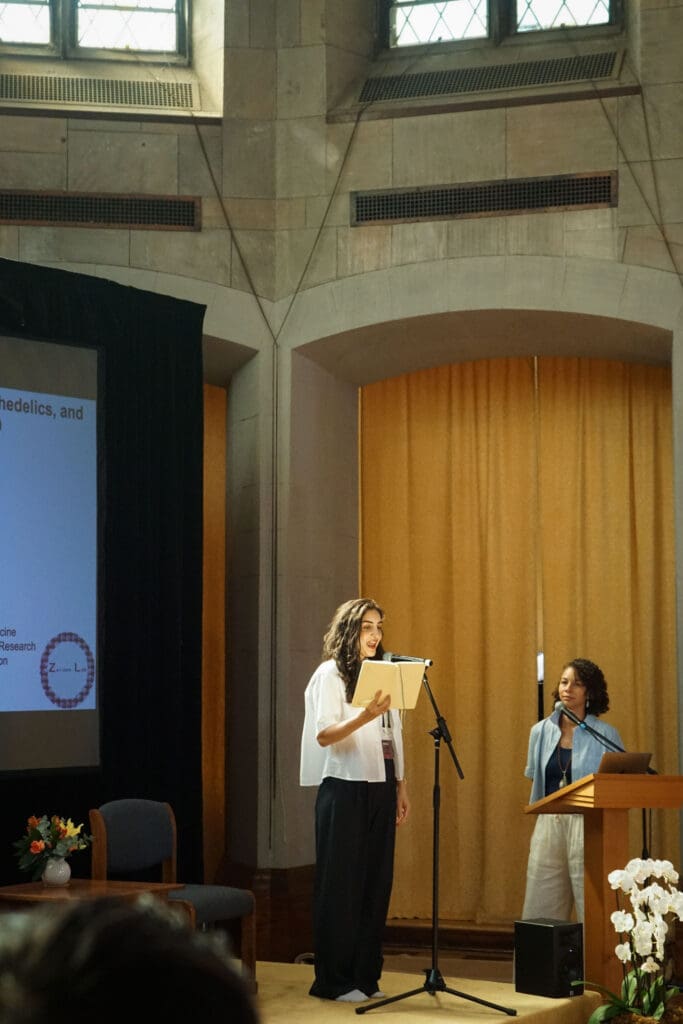
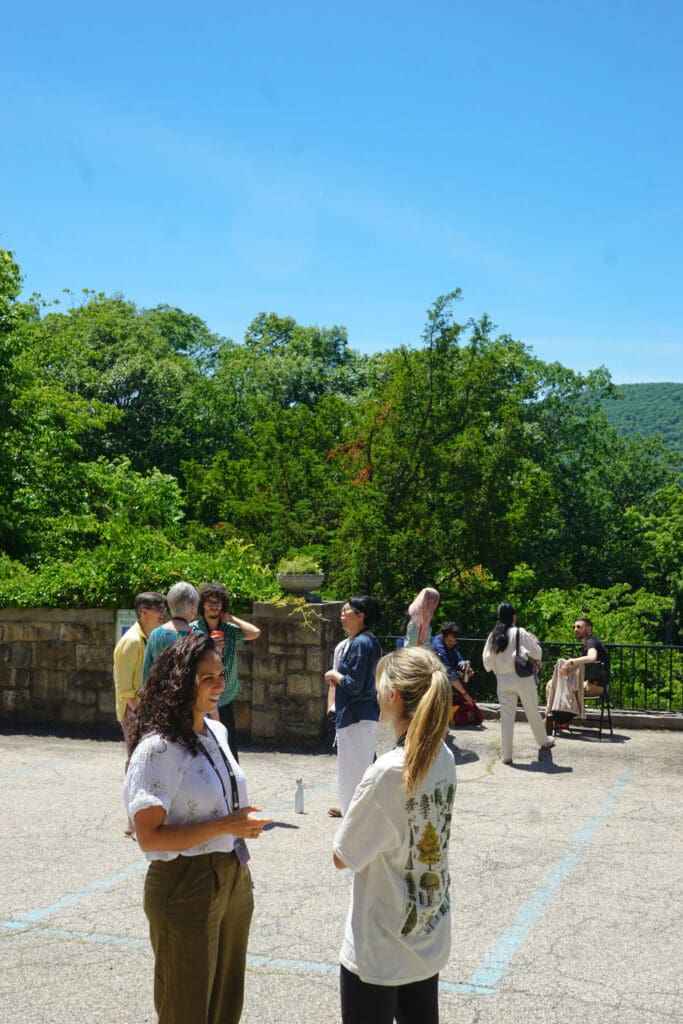
The combination of SRI faculty teachings and conversations with participants—ranging from neuroscientists and psychologists to chaplains, policymakers, educators, and artists—pushed us all into an imaginative space of becoming. From sense-making sessions to walks on the trails and drinking maté by the Hudson River, we engaged in conversations that left us collectively imagining what we might do beyond these dialogues. How might we merge our research and practice into an integrative, compassionate praxis that serves our greater communities? In what ways can we hold ourselves accountable as we seek to bridge different worlds without causing more harm in the very act of bridging? When it comes to transforming our anger into meaningful action, how might we “keep the rage tender,” as poet Nayyirah Waheed writes?
Gathering from across disciplines and geographies, the 2026 SRI community sees difference, not as a setback, but as an entry point. Committed to bridging contemplative traditions with diverse fields of inquiry, we are accustomed to living as nepantleros, people who inhabit the space between worlds. What a gift it is to gather with a community that is not discouraged by difference, but instead embraces liminality and the challenge of holding multiple truths. And so, I leave us with the words of Chicana scholar Gloria Anzaldúa, who reminds us that even though living in nepantla might make our heads spin, this in-betweenness is also a strategy of resistance, one that opens the door to new possibilities.
“Soy un amasamiento, I am an act of kneading, of uniting and joining that not only has produced both a creature of darkness and a creature of light, but also a creature that questions the definitions of light and dark and gives them new meanings.”
– Gloria Anzaldua, Borderlands
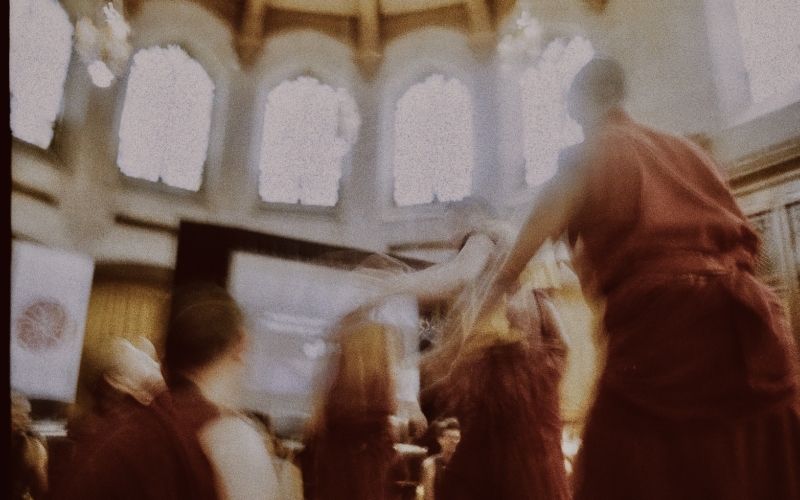


Film photography by Solei Sarmiento.
Solei Sarmiento is currently a Master of Divinity student at Harvard University and graduate researcher at the Next Level Laboratory at the Harvard Graduate School of Education. She previously earned her Bachelors in Cognitive Science at UC Berkeley.