
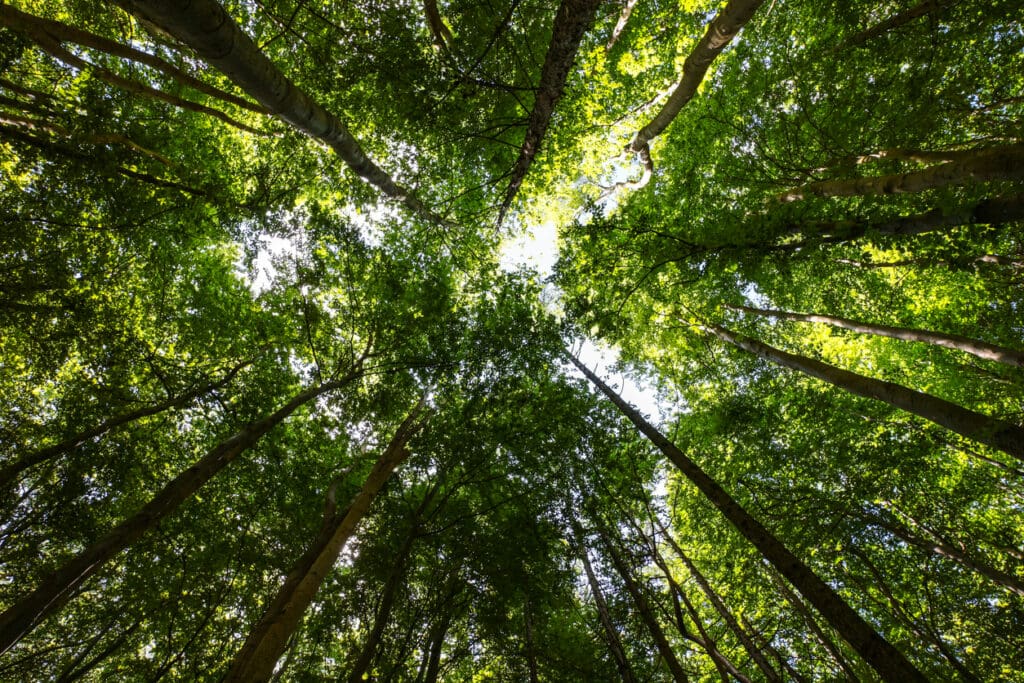
Underlying rising temperatures and climate emergencies lies a quieter rupture: our growing disconnection from the living systems that sustain us. Earth awareness practices—contemplative practices that cultivate a lived sense of interconnection with the natural world—offer promise for rekindling the reciprocal relationship between humans and the Earth. Yet without a stronger evidence base, their potential to strengthen resilience and catalyze meaningful action remains underrealized.
Closing this gap is the focus of a three-year partnership between the Mind & Life Institute and the BESS Family Foundation. Launched in February 2025, the partnership aims to advance the emerging field of earth awareness research through three interrelated goals: building community and fostering collaboration among researchers, supporting new research, and communicating insights in ways that inform both scholarship and practice.
A critical first step was forming an interdisciplinary working group dedicated to advancing earth awareness research. The group brings together 11 scholars from five countries—Chile, India, Finland, Sweden, and the United States—whose expertise spans philosophy, environmental neuroscience, environmental theology, human geography, educational psychology, biology, and Buddhist studies. This diversity reflects a shared recognition that understanding earth awareness demands perspectives that cross disciplinary, cultural, and epistemological boundaries.
Conversations among working group members have elevated shared values and challenges, with participants surfacing patterns, tensions, opportunities, and blind spots within this emerging field. Together, they have been engaging around a set of foundational questions:
- What do we mean by earth awareness?
- What kinds of practices cultivate it, and how do these vary across cultural and wisdom traditions?
- Is “earth awareness” the best descriptor, or are other terms more appropriate?
- What is the current state of research on these practices?
- Which questions are most urgent from a scientific standpoint?
- What outcomes matter most in light of today’s social and ecological challenges?
- How might these outcomes be meaningfully measured?
- Are earth awareness practices scalable and accessible across diverse populations?
- And how can research in this area engage questions of systems change?
Earth Awareness as Remembering Our Belonging
In discussions around the meaning of earth awareness, a shared theme emerged: nature connectedness is less about creating a new relationship with nature than about remembering and embodying an existing one. When asked, working group members described earth awareness as a lived recognition that human beings are not separate from the Earth, but are continuously shaped by and participating in its processes—from the air we breathe to the ecosystems that sustain us—and that our actions, in turn, shape those very systems.
“Earth awareness, or nature connectedness, for me is not about reconnecting with the natural world,” shares writer and Zen teacher David Loy in the video below. “The reality is we never have been separate and we never will be separate.” David points to the delusion of separation, adding that Buddhist practice offers a way “to let go of ourselves and overcome that delusion.”
For Lucy Schultz, Assistant Professor of Philosophy and Environmental Studies at the University of Tennessee at Chattanooga, “Earth awareness is about rediscovering and deeply appreciating [that] we are fundamentally ecological beings born of this Earth… Earth awareness is reconnecting with that, appreciating that, embodying that, and living with that.” In the clip below, Lucy reflects on when she feels most alive and deeply connected to the Earth—from contemplating the interwoven roots beneath her feet to the tree canopy overhead to the shifting formations of clouds.
Working group members emphasize the reciprocal relationship we have with nature, affirming our intraconnection with the Earth. Buddhist Studies scholar Paula Arai describes her relationship with the majestic redwood trees just outside her California home. In a region beset by wildfires, she shares how one tree hollowed out by fire “holds you in its embrace… protecting you with the vestiges of its grandeur.”
Yet earth awareness involves more than contemplating nature, it demands that we take action to protect and preserve the Earth. Says neuroscientist Jyoti Mishra, an Associate Professor at the University of California-San Diego and Mind & Life Varela grantee, “Earth awareness is to me is a sense of gratitude for what the Earth is providing to me, and then feeling the sense of responsibility I have towards the Earth—towards the planet—to sustain the sense of well-being for myself and for our current as well as future generations.”
Looking Ahead
In the coming year, the Mind & Life–BESS partnership will continue to support this working group as it deepens its understanding of earth awareness, investigates how practices that help us rediscover our inter- and intra-connection with the Earth can be rigorously studied and meaningfully measured, catalyzes and brings coherence to this emerging field within contemplative science and research, and explores how to best to share this knowledge more widely. By strengthening the scientific foundations of this work, we hope to contribute to a field capable of meeting the urgency of our time.
Suggested Resources
- Learn more about what Buddhism can teach us about the ecological crisis in Ecodharma: Loving the World as Our Own Body.
- Explore the wisdom of Indigenous communities in the Andes in this Mind & Life blog post.
- Read an essay about contemplative ecological education in India by environmental neuroscientist Pooja Sanhi.
- Tune in to the podcast as meditation teacher Liz Monson explores embodied practices for awakening to the world’s fundamental interconnection.
- Learn how forest bathing is being used to support cancer patients in Chile on the blog.
- Listen to this podcast interview as Karen O’Brien, professor of Human Geography, describes the role of quantum social change in addressing the climate crisis.