The Mind & Life Institute

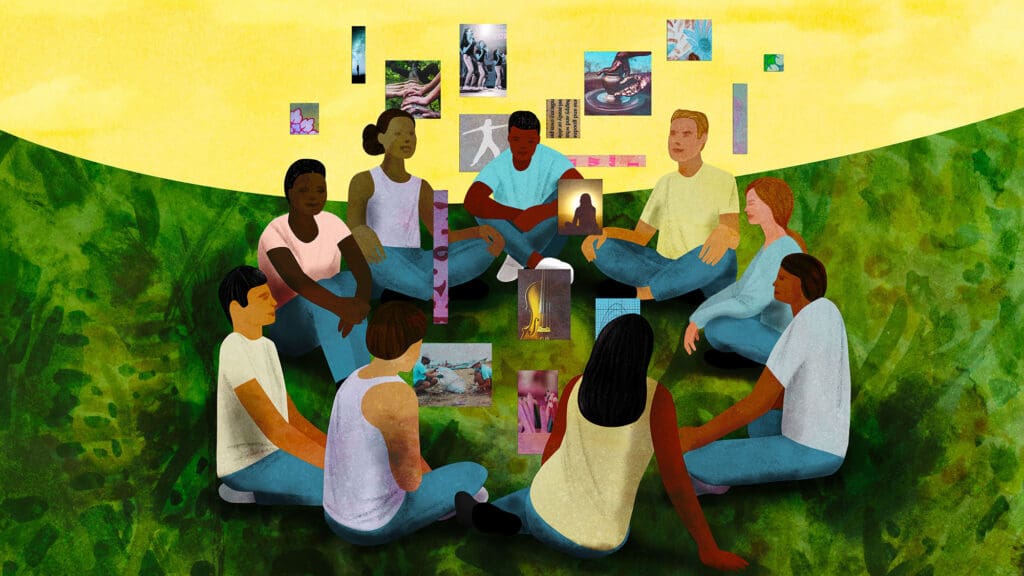
What if the solution to our most pressing environmental, educational, and emotional crises was hiding in plain sight—in the trees, the silence of a forest, or the stillness of our own breath? As a researcher and educator, I’ve spent years exploring how contemplative practices and nature, two ancient sources of wisdom, can come together to transform not just individual well-being but the systems that shape our future.
My Dayalbagh Roots and Beyond
From my very first days, Dayalbagh, a spiritual community in northern India, where nature is regarded as a living, breathing presence, shaped my world. There I was taught to see the world not as a collection of separate parts, but as whole, interconnected, sacred, and alive. The Dayalbagh way of life is rooted in ancient Indian philosophies that speak to the oneness of the individual soul with the universal spirit. Through the practice of surat shabd yoga, a meditative technique that focuses on inner sound and transcendence, I began to sense the deep unity of mind, body, and environment, a realization that still shapes how I see myself and the world.
In Dayalbagh, this understanding shapes a way of life devoted to simplicity, selfless service, and harmony with nature. Education, I came to believe early on, wasn’t just about textbooks or test scores; it was about cultivating awareness, compassion, and meaningful connection with others, with nature, and with self.
Years later, as a young engineer navigating the triple planetary crisis of climate change, biodiversity loss, and pollution, I implemented sustainability standards at a multinational pharmaceutical company. I witnessed how science and technology can solve complex problems, from reducing hazardous waste streams to developing closed-loop water systems, to optimizing supply chains to achieve a lower carbon footprint. I also saw their limits. Why did some well-funded sustainability projects thrive while others failed to take root?
My time as Program Manager for the Montreal Protocol group at the United Nations Development Program (UNDP) deepened this question. Even the strongest policies and most ambitious programs struggled in the absence of humans who cared deeply and applied themselves with conviction. This was a humbling realization. While science and policy are essential, they are not sufficient. I realized that the real missing piece wasn’t more technology or resources, it was people.
What truly drives lasting change is human behavior: our values, daily habits, and how we relate to nature. This insight is strongly supported by the Intergovernmental Panel on Climate Change’s Sixth Assessment Report (2021),1 which highlights that addressing climate change effectively requires transforming how societies live, consume, and interact with the environment.
This urgency intensified as I observed the “unmindfulness” arising from yet another global crisis, that of shrinking attention spans and growing disconnection from nature. In the last few hundred years, with advances in technology and increases in urbanization, our sensory environment has grown far more complex; yet our brains remain essentially unchanged, impacting attention, especially relevant to children and all urban dwellers, according to a recent study.2
We’ve lost touch with the natural rhythms that once grounded us. More than a cognitive issue, this is a spiritual one.
This isn’t just about screen time or stress; it’s about the erosion of our ecological identity. Unless we restore that bond, our efforts to address the triple planetary crisis and growing mental health concerns will remain incomplete.
This insight led me to a key understanding that has informed my research: if we want to solve systemic environmental and social crises, we need more than technical solutions; we need systems change. And systems change begins with a shift in collective consciousness.
If we want to solve systemic environmental and social crises, we need more than technical solutions; we need systems change.
Why? Because systems, whether educational, economic, or environmental, are shaped by the choices, values, and behaviors of the people within them. Without mindful engagement from students, teachers, parents, and local communities, even the best policies and tools remain surface-level interventions.
As systems theorist Donella Meadows wisely put it, “The mindset or paradigm out of which the system arises is the most powerful leverage point for change.”
Education as a Pathway to Planetary Healing
Drawing on my traditional roots and scientific training, I was compelled to explore how bridging ancient wisdom and neuroscience could help reimagine education and better prepare students to navigate a rapidly changing world. Ultimately, this drove my research into contemplative and ecological education. Through mixed-method studies, we now see solid evidence that blending mindfulness with nature immersion doesn’t just enrich classroom theory; it meaningfully sharpens attention, deepens empathy, bolsters emotional regulation, and fosters a profound sense of connection.
This isn’t just a noble aspiration; it’s measurable!
A comprehensive meta-analysis3 of 25 quantitative studies, encompassing nearly 3,000 participants, found that nature-based mindfulness interventions produced significant improvements across a range of outcomes. These included reductions in stress and anxiety, enhancements in mood and well-being, and improvements in self-regulation and social connection. Notably, informal nature mindfulness practices such as mindful walking in the woods or sensory exploration also appeared to yield greater benefits than more formal, seated meditation. This suggests that the unique qualities of natural settings: sensory diversity, a sense of “being away,” and the gentle pull of soft fascination may facilitate deeper engagement and restoration.
A review of qualitative studies4 further illuminates the subjective experience of nature-based mindfulness practices. Participants often reported a heightened sense of presence, increased awareness of sensory details, and a feeling of interconnectedness with the natural world. These experiences, in turn, support the development of self-awareness, emotional balance, and a more mindful approach to daily life.
Neuroscience Meets Nature
In our lab, we have used neuropsychological techniques to study how nature experience affects the brain in real time. In one experiment,5 participants were asked to complete cognitive tasks before and after a 15-30 minute immersion in a natural environment.
The results? Post-nature exposure, their brains showed increased alpha and theta waves, which are associated with relaxed alertness and emotional balance. Neural markers linked to cognitive control (like the N2 and P3 components) were stronger, especially when participants faced more mentally demanding tasks. This demonstrated a measurable boost in their ability to focus, resist distractions, and sharpen the brain functions that underpin sustained attention.
In another study6 by our research team, it was revealed that adults who grew up surrounded by nature or who spent more time outdoors as children tend to develop a deeper bond with the natural world. This connection, called “nature relatedness,” makes them more likely to seek out green spaces as they grow, and also supports greater mindfulness. The research highlights that early childhood experiences in nature aren’t just fun, they’re foundational for lifelong mental well-being. A similar study7 by another research group also suggested that people who regularly explored the outdoors as children are far more likely to become mindful, resilient adults, equipped to manage stress and fully appreciate the richness of the world around them.
Early childhood experiences in nature aren’t just fun, they’re foundational for lifelong mental well-being.
It confirmed what Shakespeare once suggested: “The earth has music for those who listen.”
We extended these findings to a neuropsychological study8 with children and found something even more remarkable. When presented with images of nature in distress, their responses change with age. Young children respond primarily with immediate emotional empathy. In contrast, older children begin to layer cognitive and reflective processes onto their concern. This developmental progression shows that empathy for nature is not static; it broadens from affective reactions to include rational reasoning.

A student participates in an EEG study to measure brain activity during exposure to nature-based imagery.
While early affective responses provide the emotional grounding for valuing nature, the cognitive aspects help children to begin to contextualize harm, think about causes, and consider possible solutions, which is crucial for shaping long-term environmental responsibility.
Without the initial sense of care, later reasoning risks being detached or purely utilitarian. Schools can harness these developmental stages by first encouraging children’s innate affective empathy through story, direct encounters with nature, and visual input, and then by guiding reflective discussions that anchor emotional concern in critical, solution-oriented thinking.
Schools that incorporate contemplative and ecological traditions into learning, through practices like silent sitting or mindfulness in nature walks, festival-based planting and harvest rituals, and elder-led storytelling about local species, help children cultivate deep empathy for nature. These insights emphasize that experiences in nature can do more than foster a love for the environment; they can also help develop skills such as emotional regulation, attention control, empathy, resilience, and mindfulness, skills children need to thrive emotionally and mentally.
It follows then that lasting environmental and social change must start early—with education.
While exploring school systems in India, we discovered some forward-thinking schools and communities that are quietly transforming education by keeping the time-tested traditions of nature-connectedness alive and weaving contemplative, agro-ecological practices into daily learning. Many of these are independent or privately operated, giving them the flexibility to step outside rigid government regulations and test innovative approaches. In these environments, where nature walks are paired with yoga and reflection is taught alongside science, something deeper is sparked in children: a sense of awe, belonging, and responsibility. These immersive approaches don’t just enrich academic knowledge; they serve as pioneering models worthy of study, nurturing the very qualities that fuel the translational work our lab is passionate about.
Take the Mahabodhi Residential Schools,9 for example. Nestled in the Himalayas, this school draws deeply from Buddhist principles, in theory and practice. Here, students begin their day with yoga and stillness meditation in nature, learning to cultivate focus and inner calm before diving into academic subjects.
Prakriti School,10 located in urban areas of the Delhi region, was inspired by Sri Aurobindo, a 20th-century philosopher and poet who emphasized harmony with nature as integral to holistic education. The open, green campus allows children to spend much of their day outdoors in farming, exploring, and working on hands-on projects that spark curiosity and respect for nature. The curriculum encourages students to observe seasonal changes, care for plants and animals, and reflect on their place in the ecosystem. Teachers act as facilitators, helping children build self-awareness, empathy, and a sense of responsibility toward the earth and each other.
Rabindranath Tagore’s Santiniketan11 is founded on the belief that education should awaken a child’s creative spirit and inner harmony through direct engagement with nature. Classes are held in the open air under trees, and students are encouraged to explore arts, literature, and science in an environment that celebrates beauty, freedom, and ecological sensitivity. This contemplative, holistic approach fosters deep awareness of the self, of others, and of the natural world.
In Sevagram Ashram,12 based on Gandhian philosophy, children learn through real-life tasks such as farming, spinning, and cleaning, blending education with self-sufficiency and ecological responsibility. This model emphasizes inner discipline, social cooperation, and mindfulness in action, offering a blueprint for sustainable, values-driven learning grounded in simplicity and service.
Dayalbagh Schools13 offer another inspiring example of how communities within semi-urban areas can play an instrumental role in integrating contemplative and ecological practices into the daily lives of children. Here, learning happens not just in classrooms, but in the fields. Even the youngest children join elders for early morning farming activities, sowing seeds and tending crops together. The practice of the “waste nothing” principle demonstrates that environmental sustainability and economic well-being can coexist. Lived experience from an early age can cultivate ecological awareness and intergenerational bonds, grounding children in community, responsibility, and stewardship.

At a school in Delhi, students learn math concepts related to shape while also gaining creativity and teamwork skills.
The decades-long experiences of these schools demonstrate that education can be transformative when it honors the whole child—mind, body, and spirit—and when it reconnects young people with the rhythms of nature and the wisdom of tradition.
This is what systems change could look like in practice, cultivating a generation that feels the Earth’s pulse as their own.
Rethinking Education for a Sustainable Future
Some of our colleagues wondered and questioned: What would it truly mean to weave contemplative and ecological education into urban schools, especially those tucked amid concrete, pressed for green space, handling large class sizes, and urged to function as engines of economic growth?
The reality is, while sprawling lawns and quiet forests may be rare in cities, transformative learning doesn’t depend on vast outdoor spaces. A growing body of research suggests that even brief “green breaks,” be it a classroom window garden, a walk to a nearby park, or mindful reflection using urban nature, can spark curiosity, restore attention, and deepen students’ connection to the environment.14 In schools stretched thin, where a single teacher may guide dozens of students, contemplative practices, like group mindfulness, collaborative learning in outdoor settings, and place-based stewardship of local community spaces, help improve classroom dynamics, foster empathy, and offer individualized engagement, even in crowded settings. These approaches also align with the push for economic vitality in the Indian context by nurturing knowledge and the practice of sustainable human–nature relations, referred to as ecoliteracy, critical thinking, and a sense of responsibility, catering to the demands of an evolving, sustainability-focused workforce.
While sprawling lawns and quiet forests may be rare in cities, transformative learning doesn’t depend on vast outdoor spaces.
Inspired by UNESCO’s Greening Education Initiative,15 which calls for sustainability to be woven into every aspect of schooling, from curriculum to culture, we set out to find out how this might work in practice. Following a whole school approach, our research team partnered with teachers, administrators, and parents from two primary schools run by Delhi University, collaborating to implement learning modules designed in our lab. The lesson plans were designed not just for boosting ecoliteracy; they aimed to nurture social-emotional skills and support academic growth.
During the three-month pilot phase at one school, with the other serving as a waitlist control, the results spoke volumes. Teachers reported greater ease in classroom management, noting a positive shift in classroom energy and heightened student engagement. School administrators appreciated the resource-efficient nature of these approaches. Simple, low-cost activities like holding classes outdoors, group meditation beneath trees accompanied by sounds of bird chirps, learning math and language using natural materials like twigs and stones found in the school backyards, observing live ecosystems, and involving students in the school garden helped create calmer, happier, and more focused classrooms with significantly improved academic learning outcomes.
The key lesson? It’s not just what we teach, but how we teach that makes all the difference.
The Theory Behind the Transformation
The profound benefits of nature-based learning and mindfulness rest on a rich blend of psychological, neurobiological, and behavioral science theories. At the neural level, increased alpha and theta brain wave activity after time outdoors supports the biophilia hypothesis,16 the idea that we are intrinsically drawn to connect with nature for emotional balance and cognitive clarity. Attention Restoration Theory17 explains how the “soft fascination” of natural settings allows our minds to recharge, while mindfulness research highlights how sensory immersion outdoors promotes presence and emotional regulation. From a behavioral science viewpoint, Self-Determination Theory18 offers insight into why these experiences are so transformative: nature meets our basic needs for autonomy, competence, and relatedness, energizing authentic motivation and resilience. Layered onto this, the Value-Belief-Norm Theory19 reveals how mindful time in green spaces strengthens our values and beliefs about caring for the planet, awakening a personal sense of responsibility and stewardship.
Put simply, when children and adults engage in mindful exploration outdoors, they don’t just restore their minds; they develop deeper motivation, connection, and an inner drive to look after the world around them.
This process embodies what I often say: learning in nature, with nature, and from nature. In this sense, nature is a living co-teacher, shaping our well-being and sense of purpose from the inside out. It’s what John Dewey called “education through experience,” and it’s proving to be one of the most powerful forms of learning.
Balancing Promising Results with Valid Concerns
Can contemplative ecological education be effectively scaled across diverse educational landscapes? Some educators and parents worry that time spent outdoors or in mindfulness practice might detract from traditional academic goals. Others point to the risk of superficial adoption, what some call “greenwashing,” where schools use the language of nature and mindfulness without committing to their deeper principles. And beyond these cultural and pedagogical challenges, the shift also carries very real costs. Implementing outdoor programs, training teachers, and redesigning curricula require funding. With education budgets often stretched thin, schools must weigh their priorities carefully.
As both a scientist and educator, I remain curious and cautious. These concerns are not obstacles to innovation, but reminders of the complexity of meaningful change. I’m deeply interested in how individual differences like age, socio-cultural background, or a student’s baseline relationship with nature might shape the real-world impact of contemplative ecological practices. And of course, the big question remains: what are the long-term effects on well-being, learning, and environmental responsibility when integrated into contemporary educational settings?
Without rigorous, long-term research and culturally responsive implementation, well-intentioned efforts in ecological education can backfire. Where programs overlook local traditions or impose unfamiliar environmental values, they risk alienating the very communities they aim to serve. Likewise, inconsistent curricula, inadequate teacher training, and neglect of individual learning needs or broader systemic barriers can erode trust and frustrate both students and educators.
That’s why meaningful teacher preparation, genuine community engagement, and an ongoing practice of reflection are essential for contemplative ecological education to truly take root and flourish in our schools.
Change Isn’t Easy
Admittedly, this isn’t a quick fix. Policymakers worry about academic trade-offs. Educators wonder how to scale such programs in overburdened systems. And yes, there’s always the danger that the practices are implemented without honoring their cultural and philosophical roots.
Systemic change takes time. As Rainer Maria Rilke reminds us, “Be patient toward all that is unsolved… live the questions now.” We must remain curious, critical, and committed.
So, how do we move from inspiration to real transformation?
First, investing in evidence-based contemplative ecological education, comprehensive teacher training, robust infrastructure, and rigorous and longitudinal research, will be key to making these practices accessible and resonant for all children.
To make contemplative ecological education sustainable, governments and school boards must move beyond pilot projects and short-term grants. They need flexible frameworks that support cross-disciplinary learning, fund teacher development, and incentivize schools to integrate well-being and environmental literacy into core curricula. Policy that encourages experimentation, reflection, and local adaptation will help this movement take root in meaningful, context-specific ways.
And we need true collaboration. By bringing together neuroscientists, educators, policymakers, and local communities, we can co-design, implement, and continually refine approaches that truly work in diverse contexts.
By embedding these practices into national curricula, we can aim to enrich the lives of students, as well as help advance broader Sustainable Development Goals around quality education, health, and sustainability—helping us stride further toward a flourishing world.
People often ask me what inspires me to keep working on this. My answer is simple: children. Children who run barefoot on the soil, who sit in silence under a tree and listen, and who ask questions not found in textbooks, questions about wonder, purpose, and connection.
From engineering labs to UN offices to neuroscience research, I’ve come to believe that the most powerful force for change isn’t policy or technology—it’s the awakened, attentive human mind.
As His Holiness Dalai Lama says, “The roots of all goodness lie in the soil of appreciation for goodness.” If we can cultivate that appreciation in our youngest citizens, we won’t just be educating them, we’ll be transforming the future.
Have something to share? Email us at insights@mindandlife.org.
Support our work with a gift to Mind & Life.
Notes
- 1.
Intergovernmental Panel on Climate Change. (2023). Sixth Assessment Report (AR6). Intergovernmental Panel on Climate Change. https://www.ipcc.ch/assessment-report/ar6/
- 2.
White, H., & Shah, P. (2019, March 25). Attention in urban and natural environments. https://pmc.ncbi.nlm.nih.gov/articles/PMC6430180/
- 3.
Schutte, N. S., & Malouff, J. M. (2018). Mindfulness and connectedness to nature: A meta-analytic investigation. Personality and Individual Differences, 127, 10–14. https://doi.org/10.1016/j.paid.2018.01.034
- 4.
Djernis, D., Lundsgaard, C. M., Rønn-Smidt, H., & Dahlgaard, J. (2023). Nature-Based Mindfulness: A Qualitative study of the experience of support for Self-Regulation. Healthcare, 11(6), 905. https://doi.org/10.3390/healthcare11060905
- 5.
Sahni, P., & Kumar, J. (2020). Effect of Nature experience on Fronto-Parietal correlates of neurocognitive processes involved in directed attention: an ERP study. Annals of Neurosciences, 27(3–4), 136–147. https://doi.org/10.1177/0972753121990143
- 6.
Sahni, P., & Kumar, J. (2021). Exploring the relationship of human–nature interaction and mindfulness: a cross-sectional study. Mental Health Religion & Culture, 24(5), 450–462. https://doi.org/10.1080/13674676.2021.1890704
- 7.
Rosa, C. D., Profice, C. C., & Collado, S. (2018). Nature Experiences and Adults’ Self-Reported Pro-Environmental Behaviors: The Role of Connectedness to Nature and Childhood Nature Experiences. Frontiers in Psychology, 9. https://doi.org/10.3389/fpsyg.2018.01055
- 8.
Sahni, P. S., Rajyaguru, C., Narain, K., Miedenbauer, K. L., Kumar, J., & Schonert-Reichl, K. A. (2024). Neural Dynamics of Development of Nature Empathy in Children: An EEG/ERP study. Current Research in Ecological and Social Psychology, 7, 100210. https://doi.org/10.1016/j.cresp.2024.100210
- 9.
Mahabodhi International Meditation Centre. (n.d.). Introduction. Mahabodhi International Meditation Centre, Ladakh. http://www.mahabodhi-ladakh.info/index.php?option=com_content&view=article&id=98&Itemid=138
- 10.
Prakriti School. (n.d.). Prakriti: A learning community. https://prakriti.edu.in/
- 11.
Bhasin, S. (2021). Ecological consciousness in Rabindranath Tagore’s Gitanjali. Indian Journal of Ecocriticism, 4(1), 45–58. https://journals.sagepub.com/doi/10.1177/0972753121990143
- 12.
- 13.
Dayalbagh Educational Institute. (n.d.). Dayalbagh Educational Institute—About. https://www.dei.ac.in/dei/index.php?option=com_content&view=category&layout=blog&id=25&Itemid=110
- 14.
Mason, L., Sella, E., Mazzella di Bosco, M., & Pazzaglia, F. (2024). Effects of green and urban environment exposure during classroom breaks in a video-based setting. Journal of Outdoor and Environmental Education, 28(1), 107–129. https://doi.org/10.1007/s42322-023-00158-w
- 15.
UNESCO. (n.d.). Greening the future: Education for sustainable development. UNESCO. https://www.unesco.org/en/sustainable-development/education/greening-future
- 16.
Wilson, E. O. (1984). Biophilia. Harvard University Press.
- 17.
Kaplan, R., & Kaplan, S. (1989). The experience of nature: A Psychological Perspective. Cambridge University Press.
- 18.
Ryan, R. M., & Deci, E. L. (2017). Self-determination Theory: Basic Psychological Needs in Motivation, Development, and Wellness. The Guilford Press.
- 19.
Stern, P. C. (2000). New Environmental Theories: Toward a coherent theory of environmentally significant behavior. Journal of Social Issues, 56(3), 407–424. https://doi.org/10.1111/0022-4537.00175