Closing Summary and Contemplative Practice

Closing Summary and Contemplative Practice

Overview


The closing session synthesized interdisciplinary reflections on artificial intelligence, emphasizing that AI should remain a human-centered tool guided by compassion, critical inquiry, and ethical responsibility. Speakers challenged deterministic narratives, advocating diverse perspectives on intelligence, consciousness, education, governance, and technological development. Discussions highlighted the importance of curiosity, epistemic diversity, democratic participation, and community engagement while cautioning against centralized power, profit-driven innovation, and anthropomorphic conceptions of AI. Participants concluded that responsible AI requires collaboration across scientific, philosophical, contemplative, and policy communities. Ultimately, they argued that human flourishing depends on preserving relationships, cultural diversity, and collective action alongside technological progress.

  • Dialogue 39
    7 sessions
  • October 16, 2025
    Dharamsala, Himachal Pradesh, India

  • share

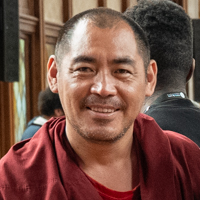
Speakers

Ani Choyang

Ani Choyang was born in Tibet and escaped to India at age 18. She became a nun in 2003 under the guidance of His Holiness the 14th Dalai Lama. She received the Rajamma Degree (similar to a Master’s degree) in 2022 after completing a 17-year course of Buddhist studies. She is in the Second year of Geshema program (equivalent to PhD). Additionally, she is a Tenzin Gyatso Science Scholar and was one of the first Tibetan nuns to attend a two-year science-training program at Emory University as part of the Emory Tibet Science Initiative. Ani Choyang also participated in a science research internship at Northwestern University in 2022, where she received in-depth training in the theory and methods of neuroscience. Currently, Ani Choyang serves as the Project Coordinator of Center for Buddhist Philosophy and Science at Jan Chub Choeling Nunnery in Mundgod, South India. She also serves as a core committee member of the Tenzin Gyatso Science Association.

Geshe Lodoe Sangpo

Geshe Lodoe Sangpo enrolled in Gaden Jangtse Monastery in 1992 and has been studying Buddhism ever since. He received his Geshe Lharampa degree in 2018. In addition to his Buddhist studies, he began studying science in 2006 and spent three years at Emory University. He currently serves as the director of the monastery's science center and the associate director of the Thudkham research project. Outside of his academic and research work, Geshe Lodoe Sangpo enjoys trekking in nature, especially through high mountain valleys.

Luc Steels

Luc Steels is Professor Emeritus in Artificial Intelligence from the University of Brussels (VUB) in Belgium. Since the early seventies, during his studies at the MIT AI lab (US), he has been using AI and robotics as a tool to investigate embodied mind, meaning, language and awareness, not only by carrying out scientific experiments but also through artistic installations and opera, with a recent work ‘Am I a strange loop?’ being shown at the 2025 Venice Biennale.

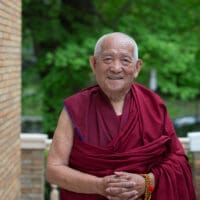
Professor Geshe Yeshe Thabkhe

Professor Geshe Yeshe Thabkhe was born in Lhokha, Central Tibet and became a monk of Drepung Loseling at the age of 13. He excelled in his studies, and eventually received his Rabjamba Degree in 1958, and later was awarded Geshe Lharam, the highest academic degree offered in the Geluk School of Tibetan Bud dhism at Drepung Monastic University. He served as a lecturer at the School of Buddhist Philosophy, Leh, Ladakh and at Sanskrit University in Sarnath. He is currently a professor of Mool Shastra (Indian Tradition of Buddhist Philosophy) at the Central Institute of Higher Tibetan Studies, the only Tibetan university in India. Professor Thabkhe is regarded as one of the most eminent scholars of both the Madhyamaka tradition and the Indian Buddhist studies. His monumental works include translation of The Essence of Good Explanation of Definitive & Interpretable Meanings (Lek-Shey Nying-Po) by Tsong-kha-Pa into Hindi, as well as A Commentary on the Rice Seedlings (Salistamba) Sutra by Kamalashila. He has also facilitated the completion of numerous research works including a complete translation of Lama Tsong kha-pa's Lam rim chen mo Great Treatise on the Stages of the Path to Enlightenment.