
This breakout session will begin with a brief introduction to two very pragmatic and embodied ways that ‘fear’ manifests in the human experience: Pain-related fear of movement (kinesiophobia) and fear of falling in older adults. An introduction will include data on the surprisingly high prevalence, individual suffering, and public health burden of these conditions, the …
Topic Archives:
Fear, Acceptance, and Compassion: Perspectives from Contemplative Neuroscience
This presentation will highlight what we know about the neuroscience of fear and anxiety and discuss its antidotes in compassion and related qualities. Distinctions will be made between fear as a state and trait. The impact of different forms of contemplative practice on the neuroscientific bases of fear and anxiety will be highlighted. Particular attention …
Continue reading “Fear, Acceptance, and Compassion: Perspectives from Contemplative Neuroscience”
The ReSource Project: Fear, Trust, and the Effects of Mental Training
The ReSource Project is a large-scale, interdisciplinary study on the effects of mental training on the brain, subjective experience, health, and behavior. Over an eleven-month period, participants practice a variety of mental exercises aimed at cultivating attention, interoceptive awareness, perspective-taking on self and others, meta-cognition, compassion, empathy, and prosocial motivation. These exercises include meditative techniques …
Continue reading “The ReSource Project: Fear, Trust, and the Effects of Mental Training”
Professional Development Issues in Contemplative Science
This breakout group will focus on professional development for those who wish to pursue a career in contemplative neuroscience. Some initial comments will be offered and then opportunities for questions and answers will be available.
Social Baseline Theory: Health, Well-Being, and the Social Regulation of Effort
High-quality social relationships help us live longer, happier, and healthier lives—facts that hold true, as far as anyone knows, regardless of geography or culture. Although links between relationships and health have been observed for decades (if not millennia), the mechanisms responsible for them remain speculative. For this talk, I’ll first describe our work on one …
Continue reading “Social Baseline Theory: Health, Well-Being, and the Social Regulation of Effort”
Positive and Negative Reinforcement – Experiencing the Forces that Form the Behavioral Repertoire
Positive reinforcement, i.e. the increase in frequency of behaviors that are associated with a desired outcome, and negative reinforcement, i.e. the increase in frequency of behaviors to avoid undesired outcomes, are the fundamental forces that shape daily behavior. However, in its extremes both processes result in rigid and potentially self-damaging behaviors. For example, excessive engagement …
To Approach or Avoid – Tension between Threat and Reward
Approach behavior occurs when an individual wants to get closer to a stimulus in the outside world that is viewed as rewarding. In contrast, avoidance behavior comprises actions that brings distance between the individual and a stimulus in the outside world and is often related to impending or experienced punishments, which threaten the integrity of …
Continue reading “To Approach or Avoid – Tension between Threat and Reward”
Richie Davidson on Meeting the Dalai Lama
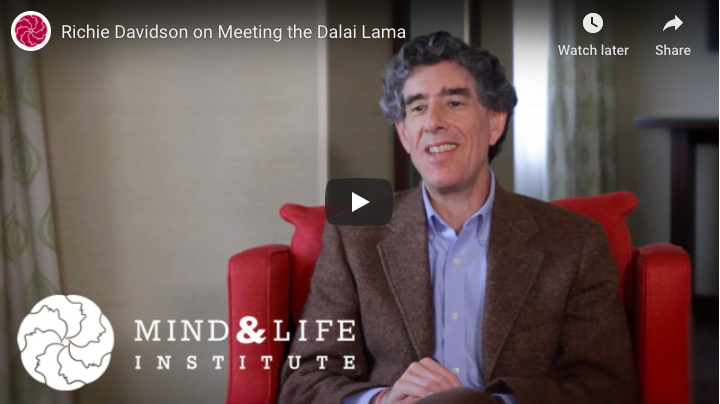
Mind & Life Institute board member and neuroscientist Dr. Richard Davidson tells the story of how meeting the Dalai Lama redirected his work towards studying kindness and compassion.
Remembrance of things to come: the predictive nature of the mind and contemplative practices
Two contemplative neuroscientists consider meditation in light of a leading theory about brain function