
James Coan, PhD (CoInvestigator) is a Professor of Psychology at the University of Virginia. His work seeks to uncover the neural mechanisms of emotion and social behavior, with an emphasis on neural systems mediating known links between social relationships and improved health. Dr. Coan’s work has been featured in Science, Nature, the New York Times, Time Magazine, NPR, the Today Show and other major media outlets. Dr. Coan received the inaugural Janet Taylor Spence Award for Transformative Early Career Contributions from the Association for Psychological Science, and the Award for Distinguished Early Career Contributions from the Society for Psychophysiological Research.
Evan Thompson is a writer and Professor of Philosophy at the University of British Columbia, where he is also an Associate Member of the Department of Asian Studies and the Department of Psychology (Cognitive Science). He works on the nature of the mind, the self, and human experience. His work combines cognitive science, philosophy of mind, phenomenology, and cross-cultural philosophy, especially Asian philosophical traditions.
He is the author of Why I Am Not a Buddhist (Yale University Press, 2020); Waking, Dreaming, Being: Self and Consciousness in Neuroscience, Meditation and Philosophy (Columbia University Press 2015); Mind in Life: Biology, Phenomenology and the Sciences of Mind (Harvard University Press, 2007); and Colour Vision: A Study in Cognitive Science and the Philosophy of Perception (Routledge Press, 1995). He is the co-author, with Francisco J. Varela and Eleanor Rosch, of The Embodied Mind: Cognitive Science and Human Experience (MIT Press, 1991; revised edition 2016).
He is currently working on two new books: Dying: Our Ultimate Transformation (Columbia University Press), and with Adam Frank and Marcelo Gleiser, The Blind Spot: Experience, Science, and the Search for Reality (MIT Press). Thompson is an Elected Fellow of the Royal Society of Canada, and a Past President of the Pacific Division of the American Philosophical Association.
Evan is featured in the Mind & Life podcast episode: Expanding Our View of the Mind.
Nilanjana (Buju) Dasgupta is Professor of Psychology and the Director of Faculty Equity and Inclusion at the University of Massachusetts–Amherst. Her research is on implicit bias. Whereas past work had assumed that implicit bias is learned early in life and difficult to change, her research shows that such bias can be changed given the right social context. Recently, her work focuses on how implicit gender bias about science and engineering shakes the confidence of women and students of color in STEM. She identifies learning environments that foster social connection, inoculates students against negative stereotypes, and promotes their confidence, persistence and success in STEM. This work has been supported by grants from the NSF and NIH. She spends a good bit of time disseminating this research to broad audiences including K-12 teachers and administrators, university faculty and campus leaders, tech entrepreneurs, federal and state policy-makers, lawyers, judges, and legal scholars.
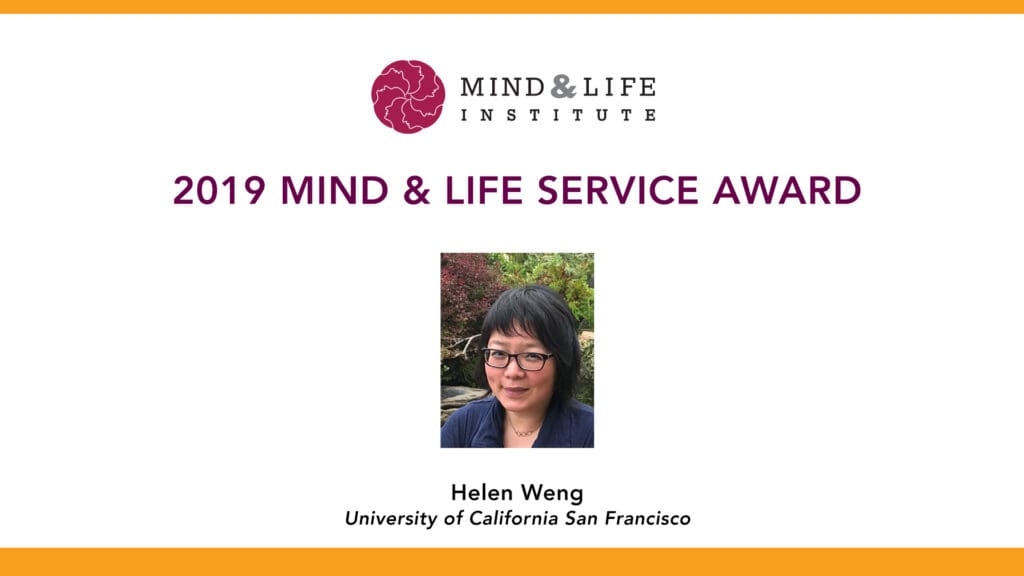
Helen Y. Weng, Ph.D., is a clinical psychologist and neuroscientist, and her research focuses on the neural mechanisms of how meditation practices may improve social behavior and mental health. Her current work involves adapting research methodology to increase diverse representation in the neuroscience of meditation from a social justice perspective. This includes using community engagement with a diverse sangha (the East Bay Meditation Center in Oakland, CA) to adopt culturally-sensitive research procedures for people of color, the LGBTQIA+ population, people with disabilities, the fat community, and people with lower income. In addition, she has designed the EMBODY Task, a novel functional MRI task which uses machine learning approaches to assess diverse and fluctuating mental states during meditation. Neural patterns are individually tailored to each meditator, and thus allow for greater neural and psychological diversity within and across meditators, while providing novel metrics of attention such as percent time focused on bodily sensations. Dr. Weng’s doctoral work from the Center for Healthy Minds, University of Wisconsin-Madison demonstrated that compassion meditation may increase both altruistic and neural responses to suffering. This work was featured in the New York Times, BBC, and Fast Company. Dr. Weng’s clinical interests include integrating compassion and mindfulness meditation with psychotherapy to treat mood and anxiety disorders, particularly for LGBTQ clients.
Helen is the recipient of the 2019 Mind & Life Institute Annual Service Award.
Marisela Gomez is a community activist, author, public health professional, and physician. She received a BS and MS from the University of New Mexico in Albuquerque; and a PhD, MD, and MPH from Johns Hopkins University. Of Afro-Latina ancestry, she has spent more than 20 years in Baltimore involved in social justice activism and community building/health research and practice. She is the author of the 2015 book Race, Class, Power, and Organizing in East Baltimore. A mindfulness practitioner in the tradition of Thich Nhat Hanh, she facilitates mindfulness retreats for activists and people of color. She blogs at HuffPost and marsielabgomez.com on the intersection of wisdom, justice, and mindfulness.
Find out more about her work here.
Bruce M. Knauft is Samuel C. Dobbs Professor of Anthropology at Emory University, Atlanta. Author of eight books and numerous articles and chapters, Dr. Knauft has special interest in cultural diversity both globally and closer to home. This includes the social, cultural, and psychological construction of power, identity, and personhood in relation to inequality and discrimination or stigma, including in areas of gender, ethnicity, race, religion, nationality, and class.
Dr. Knauft conducted his original ethnographic fieldwork—on shamanism, spirituality, and sorcery—among the remote Gebusi people of the rainforest of Papua New Guinea’s Western Province, where he continues to do fieldwork. He has also conducted engaged intellectual and activist project work concerning post-conflict developments (supported by the Ford Foundation and the Carnegie Corporation) in a dozen developing countries of east and west Africa, south and southeast Asia, and the Altai-Himalayas.
During the past decade, Dr. Knauft has developed increasing interest, as both a scholar and a practitioner, in Tibetan Buddhism, meditation, and mindfulness—both in Himalayan countries and in dharma centers in the U.S. and Canada. He also continues scholarship in areas of general anthropology, including theoretical developments concerning political economy, culture, and subjectivity. His most recent articles consider issues in Tibetan Buddhist tantra and current political developments in the U.S. His most recent books are “Mongolians After Socialism: Politics, Economy, Religion” (Co-edited, 2012) and “The Gebusi: Lives Transformed in a Rainforest World” (2016).
Suparna Choudhury is Assistant Professor and Co-Director of the Culture, Mind & Brain Program at the Division of Social & Transcultural Psychiatry, McGill University, where she works on the adolescent brain at the intersection of anthropology and cognitive neuroscience. Trained originally as a neuroscientist, Suparna has worked as a researcher in London, Paris, Berlin, and Montréal developing interdisciplinary skills to examine the implications of the new brain sciences for health and society. Her doctoral research in cognitive neuroscience at University College London investigated the development of the social brain during adolescence. During her postdoctoral research in transcultural psychiatry at McGill University, she founded the research program of Critical Neuroscience, which brings to bear perspectives of science studies and medical anthropology to examine how neuroscientists construct their objects of inquiry, and how research findings are transformed into popular knowledge and public policy. As a Research Leader at the Max Planck Institute for History of Science in Berlin, she conducted research on the cultural contexts of the adolescent brain. Her current work in Montréal investigates how the dissemination of cognitive neuroscience may shape the ways in which researchers, clinicians, patients, and laypeople understand themselves, their mental health, and their illness experiences. Ongoing projects include analysis of neuroeducational interventions including mindfulness training for adolescents; use of neuroscience in juvenile law; subjective experiences of young people taking psychotropic medications; mental health and urbanicity; interpretations of data from brain science and epigenetics in the context of maternal mental health; and the politics of open science.
Polly Young Eisendrath, PhD, is a Jungian Analyst; Psychologist; Author; Clinical Supervisor, Norwich University, Northfield, Vermont;Clinical Associate Professor of Psychiatry, University of Vermont, Burlington, Vermont; and in private practice in central Vermont. She is chairperson of the non-profit “Enlightening Conversations: Buddhism and Psychoanalysis Meeting in Person” that hosts conferences in cities around the USA. She has published many chapters and articles, as well as fifteen books that have been translated into more than twenty languages. Her most recent books are “The Present Heart: A Memoir of Love, Loss and Discovery” (Rodale, 2014); “The Self-Esteem Trap: Raising Confident and Compassionate Kids in an Age of Self-Importance” (Little, Brown, 2008); and “The Cambridge Companion to Jung: New and Revised,” of which she is co-editor with Terence Dawson (Cambridge University Press, 2008). Polly’s forthcoming book, “True Love Ways: Relationship as Psycho-Spiritual Development,” will be published in 2018.
Prof. Harris is a social neuroscientist who takes an interdisciplinary approach to understand human behaviour. His research explores the neural correlates of person perception, prejudice, dehumanization, anthropomorphism, social learning, social emotions, empathy, and punishment. This research addresses questions such as: How do we see people as less than human, and non-human objects as human beings? How do we modulate affective responses to people? How do we decide right from wrong?
Michael Onyebuchi Eze currently teaches African political theory at the University of Amsterdam and a fellow at Trinity Hall, University of Cambridge. Until recently, he was a visiting scholar at the Center for African Studies and a research associate at the Martin Luther King Jr., Institute, both at Stanford University. He is the founding Director, Center for Leadership and African Diaspora Studies, Covenant University of Nigeria. He was a Stiftung Mercator Foundation Research Fellow at the Kulturwissenschaftliches Institut (Institute for Advanced Study in Humanities) in Essen, Germany from 2006-2009. He received his Ph.D. (Summa Cum Laude) in History and Cultural Reflection from Universität Witten-Herdecke, Germany (2008), MA in Philosophy from the University of Pretoria, South Africa (2006), and BA Honours in philosophy and Classics from the Jesuit School of Philosophy in Harare, Zimbabwe (2003). He has taught at the universities of Frankfurt, Augsburg, and Colorado Christian University. He has published in many scientific journals, including two books, “The Politics of History in Contemporary Africa (2010) and “Intellectual History in Contemporary South Africa”(2010) both from Palgrave-Macmillan. A book manuscript “Religious Nationalism and Survival Politics in Contemporary Nigeria” is completed and under review with Cambridge University Press. Other scholarly peer reviewed articles include, “Pan Africanism and the Politics of History ( 2013), “Pan Africanism: A Brief Intellectual History” (forthcoming, 2013), “Humanism as History in Contemporary Africa” (2011), “The Politics of Being a Human Being In Soweto: Identity as a Social Capital” (2011), “I am Because You Are” (2011), “Pan-Africanism and the Politics of History” (2013), “Pan-Africanism: A Brief Intellectual History” (2013), “I am Because You Are: Cosmopolitanism in the Age of Xenophobia” (2017), and “Eco-Humanism: An African Environmental Theory,” among others.