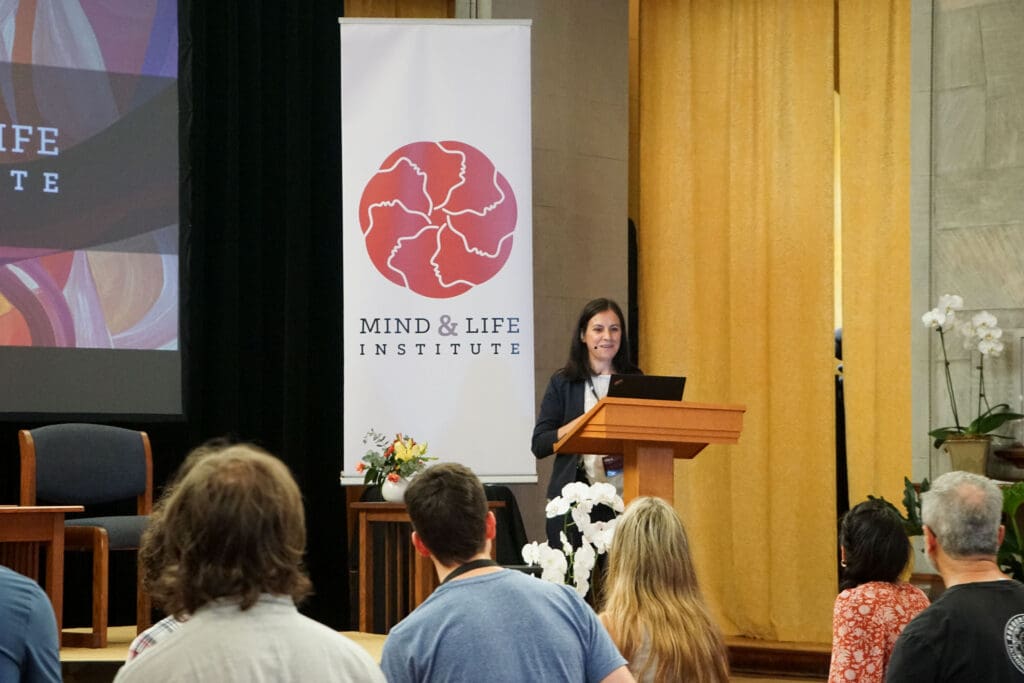
Mind & Life periodically invites guest contributors to the blog to deepen dialogue and understanding around themes central to our mission. The following post is adapted from Mara Lisa Arizaga’s presentation at Mind & Life’s 2026 Summer Research Institute.
We live in a time of profound polarization.
Across societies, communities, and institutions, disagreements can quickly harden into divisions. People are increasingly reduced to categories, positions, identities, or labels. Public discourse often rewards certainty over curiosity, reaction over reflection, and opposition over understanding.
At the same time, the challenges we face are becoming ever more interconnected. Armed conflicts, climate change, displacement, inequality, rapid technological transformation, and growing social fragmentation cannot be addressed in isolation. They require cooperation across differences. They require global alliances. They require a renewed commitment to human rights, dignity, and the alleviation of avoidable suffering. They require the capacity to remain engaged even when perspectives diverge and tensions arise.
This raises a fundamental question:
Can we still cooperate across difference?
This question leads to another:
What are the conditions that make cooperation possible?
In multilateral settings, polarization appears in many forms: geopolitical tensions, ideological divisions, mistrust, competing priorities, unequal power, historical grievances, and conflicting narratives. In these contexts, cooperation requires more than procedures, mandates, and institutional mechanisms.
It also requires trust.
It requires recognition.
It requires the willingness to remain in the room when disagreement emerges.
And it requires inner capacities that support dialogue, ethical judgment, and collective action.
The Universal Declaration of Human Rights affirms that all human beings are born free and equal in dignity and rights.
This idea is both simple and profound.
Before any law, policy, or agreement, there is an act of recognition. We recognize that dignity is inherent. We recognize that each person is a rights-holder. We recognize that suffering, exclusion, and harm matter. We recognize that every life has value.
Yet such recognition is not always easy.
It becomes especially difficult when emotions are strong, when histories of harm are present, when pressure increases, or when disagreement feels threatening.
This is where compassion becomes particularly important.
Compassion helps keep suffering visible.
It reminds us that behind every policy debate, every conflict, every disagreement, and every statistic are lived realities.
Behind displacement are families leaving their homes.
Behind discrimination are daily experiences of exclusion.
Behind conflict are communities carrying loss, uncertainty, and grief.
Compassion does not require agreement.
It does not replace accountability.
It does not weaken the demand for justice.
Rather, compassion helps ensure that suffering, exclusion, and harm do not become invisible.
It allows us to respond with greater wisdom and care while remaining grounded in principles, evidence, and dignity.
Presence is equally important.
Presence is the capacity to remain with complexity before reacting, simplifying, or withdrawing.
It creates a space between stimulus and response.
It allows us to listen more carefully, perceive more clearly, and respond more wisely.
In difficult conversations, presence can help keep a door open.
In moments of tension, it can prevent escalation.
In leadership, it can help us notice what a situation, a team, or a community may actually need.
Discernment is another essential capacity.
Discernment asks not only what is possible, but what is most responsible.
It helps us navigate complexity without becoming overwhelmed by it. It supports ethical action under conditions of uncertainty, competing demands, and limited information.
Without discernment, compassion can lose direction.
Without compassion, discernment can become detached from human consequences.
Together, they support action that is clear, careful, and grounded in dignity.
Connection also matters.
Connection allows us to move beyond categories and roles. It invites us to encounter one another as participants in a shared world, connected through relationships of mutual dependence, responsibility, and care.
This does not eliminate disagreement.
Nor should it.
Diverse perspectives are essential for healthy societies and effective institutions.
The challenge arises when disagreement turns into dehumanization, when trust breaks down, and when the dignity of others becomes difficult to recognize.
In such moments, the path forward requires more than better arguments.
It requires the restoration of recognition.
It requires compassion strong enough to keep suffering visible, discernment clear enough to guide responsible action, presence steady enough to remain with complexity, and connection deep enough to sustain dialogue across difference.
This does not mean abandoning principles or avoiding difficult conversations. Violations must be named. Facts must be established, and truth must be acknowledged. Accountability remains essential. The commitment to uphold human rights remains essential—for all people, everywhere. Compassion, in this sense, is not about excusing harm. It is the capacity to keep suffering visible while acting with clarity, integrity, and respect for dignity.
These aspirations are not always realized. Around the world, many individuals and communities continue to experience profound injustice, violence, and suffering. Precisely because that reality persists, the work of cultivating the inner capacities that support wise, courageous, and compassionate action remains both urgent and necessary.
At the same time, durable progress requires more than conviction alone. It requires the ability to remain grounded in dignity while engaging constructively across difference.
These capacities are not new.
Across cultures, philosophical and spiritual traditions, Indigenous knowledge systems, and contemporary scientific inquiry, people have long explored how awareness, compassion, wisdom, and ethical responsibility can be cultivated.
They have been carried in many languages, practices, and ways of knowing—in communities, lineages, rituals, forms of practice, service and ethical reflection, and relationships with land, nature, and community. The task ahead is not simply to study them from one perspective, but to bring these forms of knowledge into respectful dialogue and co-creation, in service of human rights, dignity, cooperation, and the alleviation of avoidable suffering.
Today, these capacities may be more important than ever.
The deeper question is how these capacities can help us sustain relationship—with one another, with the living world, and with the institutions and alliances needed to uphold human rights, dignity, and peace for all.
The challenges of our time call for technical expertise, political leadership, institutional innovation, and global alliances.
They also call for inner capacities that support cooperation.
This is where the idea of solutions from within becomes important.
Solutions from within are not separate from social change. They are the capacities that allow individuals, communities, and institutions to respond to outer challenges with greater clarity, compassion, responsibility, and wisdom.
Peace is sustained through agreements, law, diplomacy, institutions, and cooperation.
It is also sustained through the capacities that make cooperation possible.
In a polarized world, perhaps one of the most important questions is not simply what we believe.
It is whether we can continue to recognize dignity across difference.
Whether we can remain present when tensions arise.
Whether we can act with compassion without losing clarity.
Whether we can uphold accountability without dehumanization.
Whether we can listen deeply enough to understand what is at stake, even when we disagree.
And whether we can cultivate the inner capacities that allow cooperation to flourish in service of human rights, dignity, justice, and peace.
The Universal Declaration of Human Rights begins with the recognition of the inherent dignity and equal rights of all members of the human family.
Perhaps one of the great challenges of our time is learning how to embody that recognition more fully:
in how we listen,
in how we decide,
in how we negotiate,
in how we lead,
in how we protect,
in how we care for the communities and ecosystems of which we are part,
and in how we relate across difference.
Cooperation, in this sense, is not only a political or institutional task.
It is a practice of relationship—with one another, with the living world, and with the alliances needed to uphold human rights, dignity and peace, for all people, everywhere.
Mara Lisa Arizaga, PhD is Head of the Well-being Unit, UN Human Rights Office (OHCHR).
This essay reflects the author’s perspective and is published as part of Mind & Life’s commitment to fostering thoughtful dialogue at the intersection of science and contemplative wisdom.