
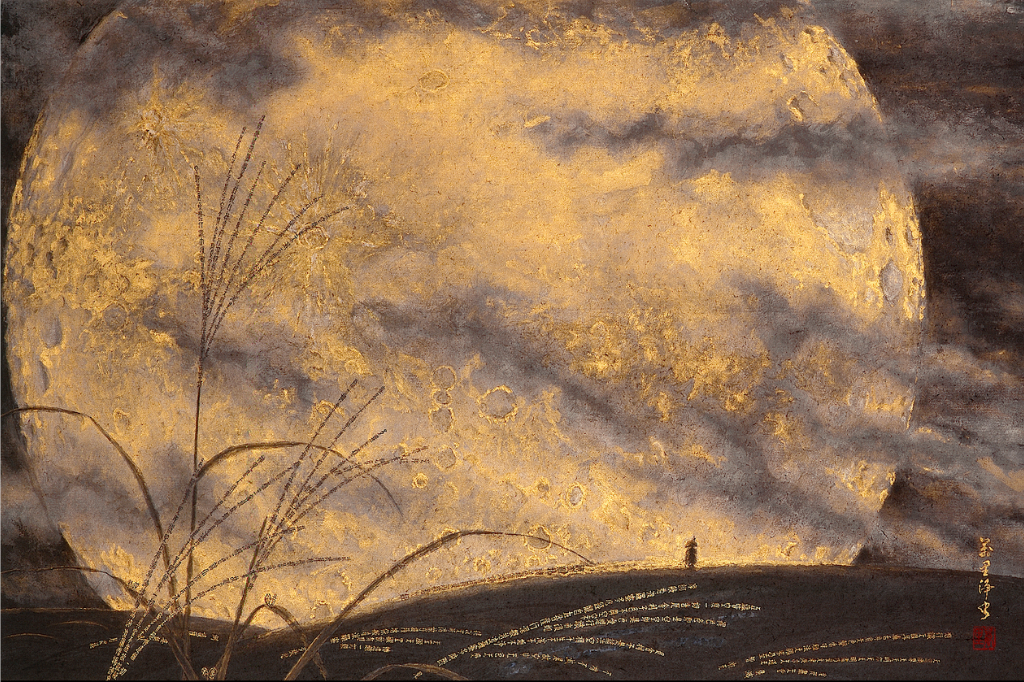
Mind & Life periodically invites guest contributors to the blog to deepen dialogue and understanding around themes central to our mission. In the reflection below, Buddhist scholar Paula Arai shares how her scholarship on women and Buddhism has shaped her contributions to Mind & Life’s Earth Awareness Working Group.
When I joined Mind & Life’s Earth Awareness Working Group, I found a community engaged in many of the questions that have long shaped my work. The conversations deepened my appreciation for the essential role that the humanities, and especially the arts and ritual, play together with the sciences in cultivating earth awareness. They affirmed that understanding our relationship with the living world requires not only scientific inquiry, but also the wisdom, imagination, and meaning-making that emerge through human experience.
It was always easy for me to see how scientists are helping us to understand—and respond to—the incomprehensibly vast and complex situation facing our planet, and I am infinitely grateful to those who are doing this rigorous and trailblazing work.
It has been harder to see how the personal and intimate nature of my work could make a difference. Yet, I knew in my bones that my ethnography of Japanese Zen nuns and qualitative research on elder Japanese Buddhist women’s healing practices and rituals had touched many lives. Many people also shared stories of how my book on a previously little-known Japanese biologist and his Heart Sutra art—masterpieces created in solitude that I literally retrieved from a closet—expanded their minds and healed their hearts.
Until recently, however, the male gatekeepers of my home field of Buddhist Studies—itself aiming to be taken seriously like science—did not offer a warm welcome to these pioneering efforts. Being a woman working on women, emotions, bodies, and visual teachings, rather than texts, was apparently hard to quantify. Empowered by fellow working group member Karen O’Brien and her book, You Matter More than You Think, I began to see ways my humanities focus on healing, rituals, art, and liberative storytelling contributes to the interdependent process of caring for our earth.
I began to see ways my humanities focus on healing, rituals, art, and liberative
storytelling contributes to the interdependent process of caring for our Earth.
Yes, the scale of the situation requires innovative research and big action. The Earth and all its plants and animals need healing. Governmental, educational, and economic structures do, too. For each of us to make our contribution, most people need healing, too. It is a rare person who can live in these dystopian times of devastation and not be negatively impacted. The very interdependence that connects us, though, is our source of healing.
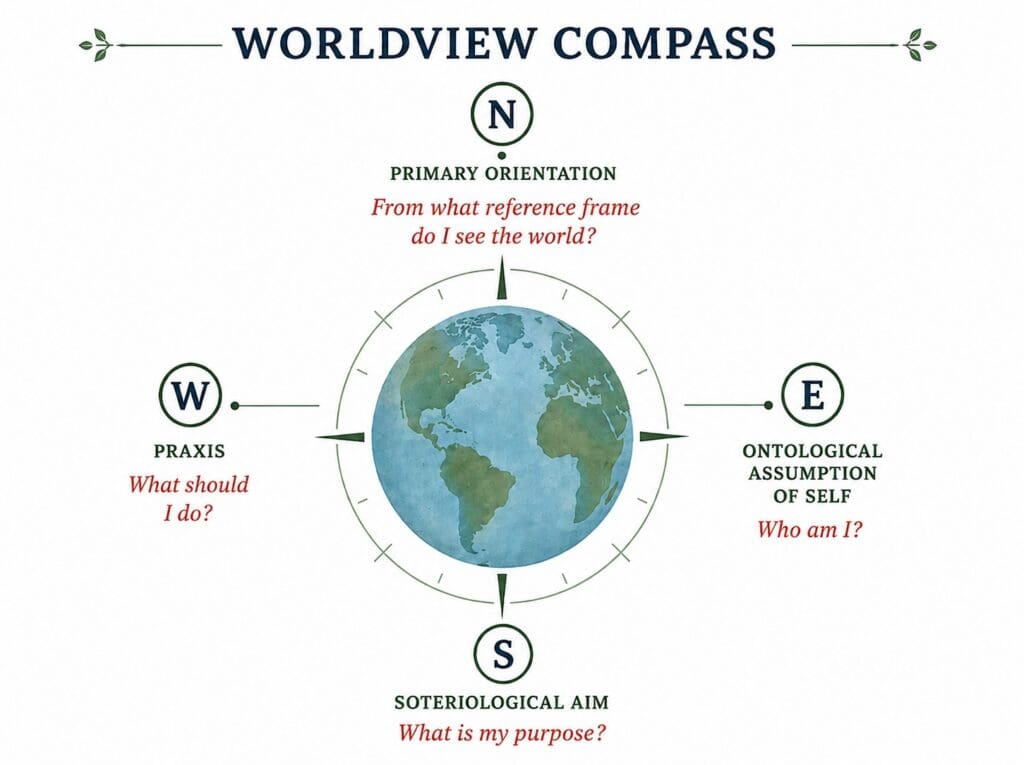
Being born out of the ravages of World War II––to a Japanese mother from Yokohama and an Anglo father from Detroit––gave me insights into the micro-dynamics of navigating diverse root assumptions about the nature of reality, differing needs and dreams, and differing experiences of oppression and domination. I created a Worldview Compass to help me and my students see and analyze religious traditions, cultures, communities, families, and people, including themselves. The analysis required to use the compass also promotes self-reflexivity, which is germane to nuanced research and working effectively in complex systems. It can be used to expand one’s purview to consider the worldview of trees, waterways, and butterflies, not to mention the worldviews of oligarchs and multi-national corporations.
The scale at which I discerned the healing paradigm of 12 elder Japanese Buddhist women consisted of one-on-one interactions for 14 years. In the 15 years since Bringing Zen Home was first published, I have received robust feedback that the 10 healing activities (see below) I derived from their experiences are effective for people in a wide range of religio-cultural contexts. Integrating these activities into an earth awareness approach might help the Earth heal, too.
Ten Healing Activities Derived from Elder Japanese Buddhist Women
- Experiencing Interrelatedness
- Living in Embodied Awareness
- Orchestrating Rituals
- Nurturing Self
- Enjoying Life
- Creating Beauty
- Cultivating Gratitude
- Accepting Reality As It Is
- Expanding Perspective
- Embodying Compassion
While in the throes of field research on healing rituals, one of the women I was working with introduced me to the art of Japanese biologist and visionary artist Iwasaki Tsuneo 岩崎常夫 (1917-2002). He merges the streams of Buddhism, science, and artistry in his life and ink paintings made with the tiny characters of the Heart Sutra, including images of atoms, DNA, dewdrops, waterfalls, full moon, nebulae, and black holes. His art shrinks and expands us. It helps us see ourselves as part of a greater whole, an integrated vision of visceral and emotional wholeness. It changes us.
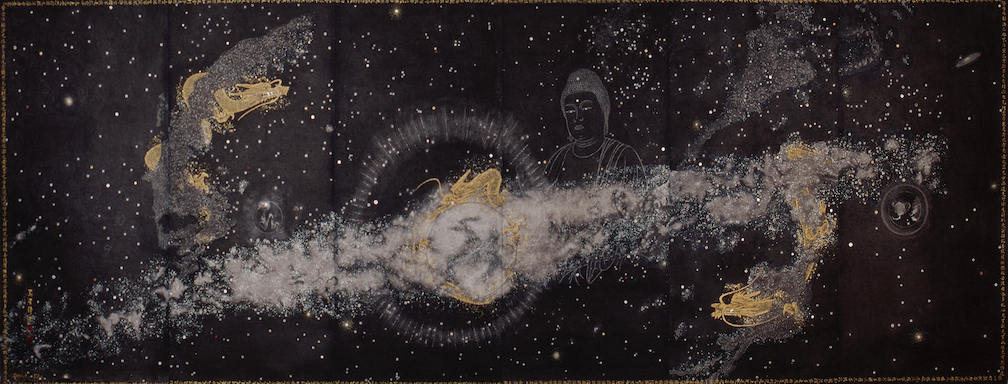
“Big Bang: E = mc2” is Iwasaki’s 17’-wide magnum opus. In his otherwise textbook accuracy of astrophysical phenomena, including dragons protectively swirling around star nurseries (nebulae) and a compassion-emanating diaphanous outline of Amida Buddha intimate Iwasaki’s view that forces beyond the ken of science are active in our cosmos. A pilgrim on one of planet Earth’s mountain tops gazes out at our Milky Way (lower left corner). Each little spot shining through Dark Matter is a galaxy, animated by a character of the Heart Sutra whose primary teaching is “Form is emptiness, emptiness is form.” (For more, see my book Painting Enlightenment: Healing Visions of the Heart Sutra and iwasakitsuneo.com)
One of my other offerings to the emerging field of earth awareness is nine liberative storytelling principles to create visions of people responding to unfair, unjust, and painful situations with a sense of empowerment, strategic wisdom, and compassion (see below).
Nine Liberative Storytelling Principles
- Sincerely care for suffering to stop
- Breathe space for not knowing
- Look through expansive and contextualized lenses
- Account for our interdependence
- Navigate with one eye on ideal aims and another eye on raw realities
- Move through an embodied perspective
- Assess whether a teaching or practice generates suffering
- Assume beings want to stop suffering
- Imagine how people and ecosystems can wield liberating power in response to negative treatment, structures, or environments by learning stories of how they have done so in the past, imagining how they might do more in the future, and poignantly narrating what we are doing in the present
Creativity and imagination are potent tools for liberative and healing change. Let’s write stories that imagine people caring and aware of each other and Earth. They just might save our lives.
Being part of the Earth Awareness Working Group, I finally feel at home.
Paula Arai, PhD is an American professor and Buddhist studies scholar, specializing in the academic study of women and Buddhism, specifically Jōdo Shinshū Buddhism and Japanese Sōtō Zen women. Her most recent book is Of Mud and Lotuses: Dreaming the Lives of Buddhist Women. During a recent retreat of the Earth Awareness Working Group, she and fellow participants composed an Earth Awareness Sutra.