
Mind & Life periodically invites guest writers to contribute to the blog. Below, climate emotions researcher Panu Pihkala reflects on eco-anxiety and the emotional and existential dimensions of the climate crisis—and how meaning, community, and contemplation can help us navigate them. Panu served as a member of Mind & Life’s earth awareness working group in 2025.
In the early 2000s, when I began studying environmental issues, there was very little discussion—either in academic research or among the general public—about the emotions connected to ecological crises.
People clearly had strong emotional responses to environmental problems: anxiety, sadness, anger, confusion. Yet these feelings were rarely addressed directly. Together with colleagues, I began exploring a simple question: why were emotions about environmental change so often left out of the conversation?
That question eventually led me to focus my research on what we now call eco-emotions—the complex emotional responses people experience in relation to ecological crises. Over time this work has grown into an interdisciplinary field involving psychology, education, environmental studies, and spirituality. My own background includes research in religion and ecology, and I have increasingly come to see that the emotional, existential, and spiritual dimensions of our changing planet are deeply intertwined.
Understanding climate change is not only an intellectual challenge—it also engages our emotional lives and deeper questions of meaning.
I have increasingly come to see that the emotional, existential, and spiritual
dimensions of our changing planet are deeply intertwined.
Understanding Eco-Anxiety
Eco-anxiety is perhaps the best-known term connected to climate emotions, though it is often misunderstood. Anxiety itself is a broad concept. At one extreme it can mean intense distress or chronic stress, but at a more basic level anxiety is a natural response to perceived threats and uncertainty. In that sense, eco-anxiety can be understood as a rational reaction to the ecological challenges we face.
In my research, I have explored eco-anxiety through what I call a process model of eco-anxiety and ecological grief. This model describes phases of awareness, and the emotional dynamics that follow.
People often begin in a stage of relative unknowing, when the seriousness of environmental problems has not yet fully registered. This may shift into partial awareness and eventually into a deeper awakening to the scale of the ecological crisis. Once this awareness takes hold, individuals typically enter a longer process of adjustment.
Within this process, three forms of engagement tend to interact. People may move toward action, channeling their concern into activism, professional work, or changes in lifestyle. At the same time, there is often a need to acknowledge grief and other difficult emotions related to ecological loss. A third dimension involves forms of distancing, which can include rest, self-care, or sometimes temporary avoidance when the issues feel overwhelming.
These dimensions don’t occur in isolation; rather, people move among them over time. Maintaining balance is crucial. If someone remains exclusively in one mode—for example, constant action without emotional processing or rest—there is a greater risk of burnout or severe anxiety.
Navigating eco-emotions, therefore, is not about eliminating difficult feelings. It’s about learning how to engage with them in ways that are sustainable.
Naming What We Feel
One helpful step in this process is simply learning to name our emotions. Psychological research shows that identifying feelings—even approximately—can reduce distress and increase emotional understanding.
For this reason, emotion wheels are often used as tools for reflection and discussion. In 2023, the Climate Mental Health Network developed the Climate Emotions Wheel, drawing partly on my research. It was an honor to serve on the working group behind it.
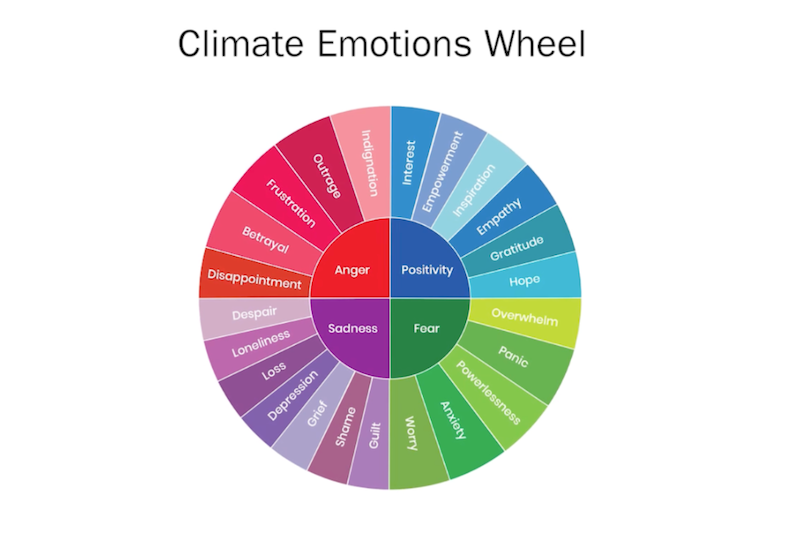
The wheel visualizes a wide range of emotions related to climate change. Alongside anger, fear, or sadness, it also includes feelings such as solidarity, empowerment, and hope that may arise when people take action together. The tool has now been translated into nearly forty languages and is used in many contexts, from classrooms to community discussions.
Many people find it surprisingly meaningful simply to see their emotions represented. Naming these feelings can help individuals realize that their reactions are both understandable and widely shared.
Meaning, Community, and the Search for Hope
Because of my work on eco-anxiety, I am frequently asked about the role of hope, drawing from my book Päin helvettiä? Ympäristöahdistus ja toivo (Eco-Anxiety and Hope).
Yet over time I’ve come to think that meaning may be an even more fundamental concept than hope. In troubled times, we may not always feel optimistic about the future, but we can still experience meaning in our lives and in our relationships with others. That sense of meaning can support our ability to act, even when optimism is difficult.
In troubled times, we may not always feel optimistic about the future, but we can still
experience meaning in our lives and in our relationships with others.
Community plays a central role here. Having trusted companions—people with whom we can talk honestly about ecological concerns—can make a big difference. Research and educational materials can help people understand their experiences, but meaning ultimately grows through shared reflection, creative expression, and relationships with both people and the natural world.
Embodied and Spiritual Dimensions
In recent years, my work has increasingly brought together eco-emotion research with questions of spirituality and contemplative practice. The ecological crisis raises profound existential questions about how we live, what we value, and how we remain connected to the Earth. I believe we need stronger cultural and community skills for engaging with these deeper dimensions.
Contemplative practices can be an important part of this. Ideally they would be woven into everyday life—moments of silence, time spent outdoors, or mindfulness practices that help us remain present with our experiences. For me personally, spending time in nature and practicing forms of somatic awareness are essential ways of sustaining my work.
Communities can also develop rituals that help people respond to ecological loss. Some groups organize gatherings that acknowledge ecological grief when landscapes or species are lost. Others create rituals that express gratitude for the living world and strengthen bonds of empathy and care. These practices remind us that responding to environmental crises is not only about policy or technology. It is also about how we cultivate emotional and spiritual resilience.
Grief and Joy
Much of my recent work has focused on ecological grief—the sadness that arises from environmental loss. Yet grief is rarely isolated from other emotions. In many cases, grief is deeply connected with joy. Both emotions emerge from caring.
One example comes from the international network Radical Joy for Hard Times, which encourages people to engage directly with damaged places in nature. Often our instinct is to avoid such places because witnessing ecological harm can be painful. But when people return to these landscapes—spending time there, acknowledging losses, and remaining in relationship with them—they often discover something unexpected.
Alongside sadness or outrage, moments of connection and even joy may arise. Some participants call this “deep play,” a process in which grief and joy strengthen one another and keep our emotional channels open.
In an era of ecological crisis, this openness may be one of our most important capacities. Staying emotionally connected to the Earth—through grief, gratitude, action, and community—allows us to remain present to both the challenges and the possibilities of the living world.
Panu Pihkala, PhD, is an adjunct professor of environmental theology at the University of Helsinki and an internationally-recognized researcher of eco-anxiety and climate emotions.