
For nearly four decades, Mind & Life has asked a foundational question: what inner capacities help people and societies flourish? Increasingly, we are turning to a related question: how does that understanding actually reach the systems, institutions, and policies that shape people’s lives at scale?
For the contemplative research field, systems change means finding better ways to turn research into real-world impact—and creating the conditions for that impact to last. That includes understanding where the work is making a difference and how research insights can inform practice, programs, and policy. It is less a new direction than a natural next step for the field.
Why Implementation Is the Next Frontier for Systems Change
That case was made with particular clarity last month when Mind & Life Board Chair Sona Dimidjian shared reflections from her own research career with our academic community in a virtual town hall. Ten years ago, Dimidjian and longtime collaborator Zindel Segal mapped the field’s published studies of mindfulness-based interventions onto the National Institutes of Health’s (NIH) staged model of clinical research—a framework that moves from basic research through to the effectiveness, dissemination, and implementation work needed for genuine public health impact. A recent ten-year update to that review, drawing on roughly 1,200 studies, found real progress: methodological rigor has strengthened and the field’s scope has broadened. But the proportion of studies at the later, implementation-focused stages has grown only modestly. Most research remains concentrated earlier in the pipeline—long on efficacy, still short on the harder, slower work of understanding what it takes to deliver these practices well, at scale, in the real world.
The finding helps clarify what systems change can look like in practice. Rather than moving away from the research Mind & Life has long supported, it builds on that foundation and asks how research can contribute to change at a broader scale.
A Community Naming the Same Challenge from the Ground Up
That same conversation surfaced how squarely this challenge sits inside the institutions researchers and practitioners work within every day. Town hall participants described the difficulty of sustaining school-based programs through leadership turnover and shifting institutional priorities as well as the way academic incentives reward publishing new findings more than the slower work of applying them—a mismatch that falls hardest on people at early- and mid-career stages who have the least security to carry the work forward. Even well-evidenced practices struggle to take root when the systems around them are unstable. Translating research into lasting benefit means attending not only to what works, but to the conditions—institutional, structural, human—that determine whether it can last.
Early, Concrete Steps
This past year, Mind & Life took several concrete steps in this direction. For starters, we revisited our grantee request for proposals to encourage applicants to think in practical terms about the larger impact they seek to achieve. We also launched a Mind & Life podcast mini-series on systems change with guest host Jamie Bristow, bringing together researchers and practitioners working at the intersection of inner development and collective transformation.
“For a long time, the central question was why inner work should matter at all in the context of systems change,” says Bristow. “But as that case has begun to be heard in more places, the question that has become more salient is how.” Across six episodes, Bristow and guests whose work spans trauma healing, Theory U, and social and ecological mindfulness, explore not just why inner-led change matters, but how it is already shaping real-world transformation.
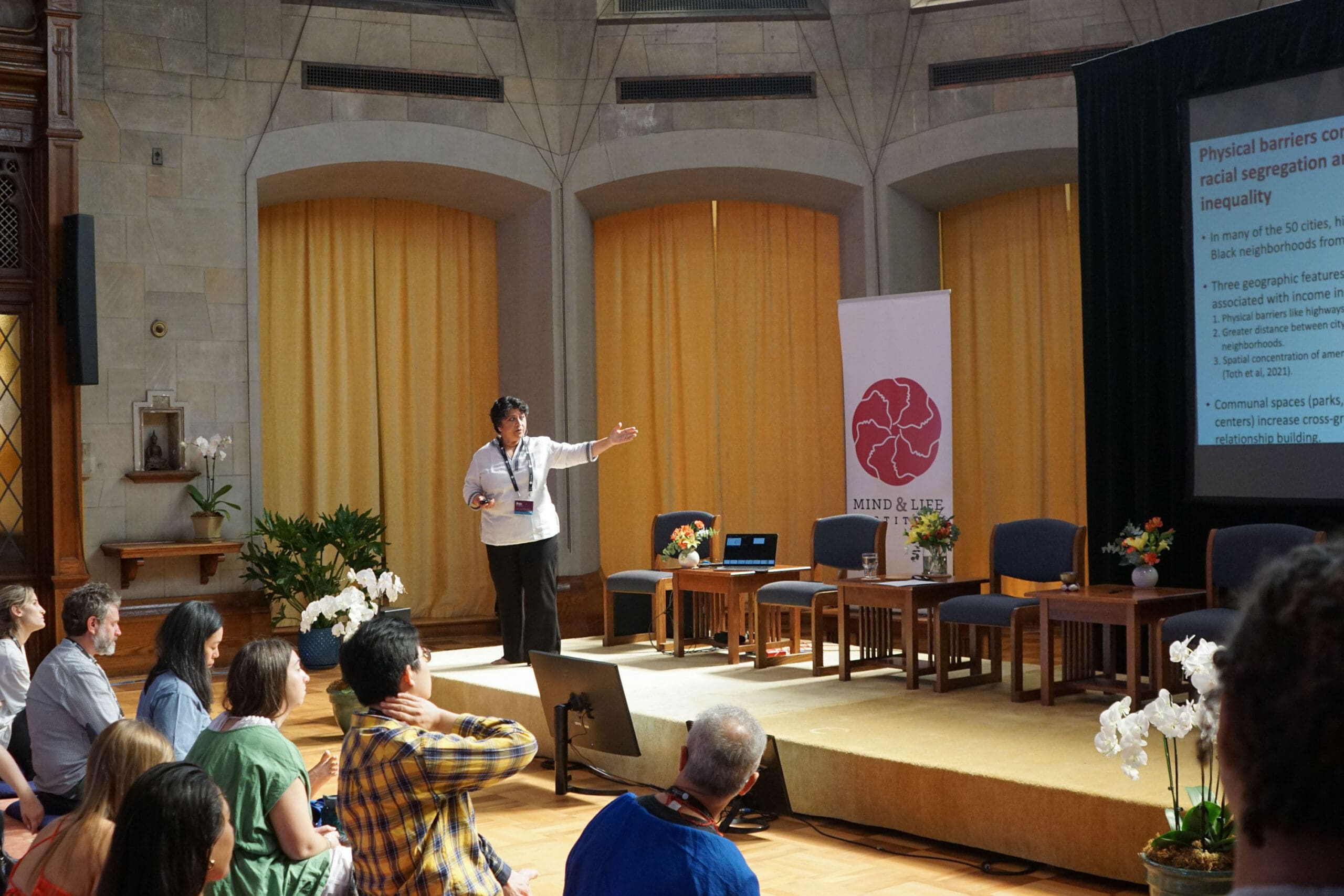
At Mind & Life’s 2026 Summer Research Institute (SRI), several speakers invited participants to look beyond individual-level interventions and consider the larger systems that shape polarization, behavior, and social connection. Buju Dasgupta described the “cultural wallpaper” of social norms, stories, relationships, physical environments, and institutions that quietly shapes how we see and relate to one another, arguing that lasting change requires reshaping those conditions, not simply changing individual hearts and minds. This theme was echoed by David Broockman, who urged participants to “look upstream” at the political, media, and institutional incentives that continually reinforce polarization.
A New Collaboration with the United Nations
As part of our systems change focus, Mind & Life has also entered into a new collaboration with the Well-being Unit of the UN Office of the High Commissioner for Human Rights to explore how research on inner capacities such as compassion, attention, and ethical discernment can support well-being, leadership, and institutional effectiveness within the UN system. The collaboration offers an opportunity to learn how contemplative research can move into practice within a complex global institution.
The partnership is still in its early stages. For now, the focus is on building relationships, contributing knowledge, and creating opportunities for shared learning. Most recently, we welcomed Mara Arizaga, who leads the Well-being Unit, as a plenary speaker at our 2026 SRI. There, she posed a question at the heart of this emerging work: What would it mean to develop “a field of contemplative capacities for global governance, human rights, and international cooperation—a field that is grounded in service, in evidence, in practice, and in responsibility,” while “supporting people and supporting institutions to respond more wisely, more ethically, and more humanely in a polarized age, in a polarized world?”
Bringing Compassion to Finance
Mind & Life is also partnering with White & Case, a leading international law firm, to host the 3rd Annual Compassion in Finance Summit taking place in October. We have assembled an outstanding agenda and speaker lineup including leading contemplatives and scientists as well as leaders from finance, investing, and philanthropy to explore how compassion can move from aspiration to action to change the financial services industry globally. We will have a panel discussion on the nature of mind followed by breakout sessions related to AI, culture, leadership, investment, and the cultivation of compassion.
Mind & Life has long sought to make insights from science and contemplative traditions accessible and relevant to society’s most pressing challenges and participating in conversations with leaders across different sectors is one way we advance that mission. Our involvement in the Summit reflects our commitment to public engagement, dialogue, and the responsible dissemination of knowledge.
Systems change is a developing focus of our work, and we’ll be sharing more as it unfolds. Sign up for Mindstream, our monthly newsletter, to follow along. Consider making a gift to Mind & Life to help us bring this work to life. The road ahead is not only about discovery. It is about stewardship—carrying what this field has learned into the systems that most need it, and building the relationships and infrastructure that let that learning last.