
While working with stressed adults, and especially women, struggling with the long-term effects of early life adversity, contemplative researcher Joanna Guan had a recurring thought: we could have intervened earlier. But implementing early mindfulness interventions for children hasn’t exactly been straightforward. School-based mindfulness programs have proliferated in recent years, yet studies like the massive My Resilience in Adolescence (MYRIAD) Trial in the United Kingdom found virtually no benefits for thousands of adolescents compared to control groups.
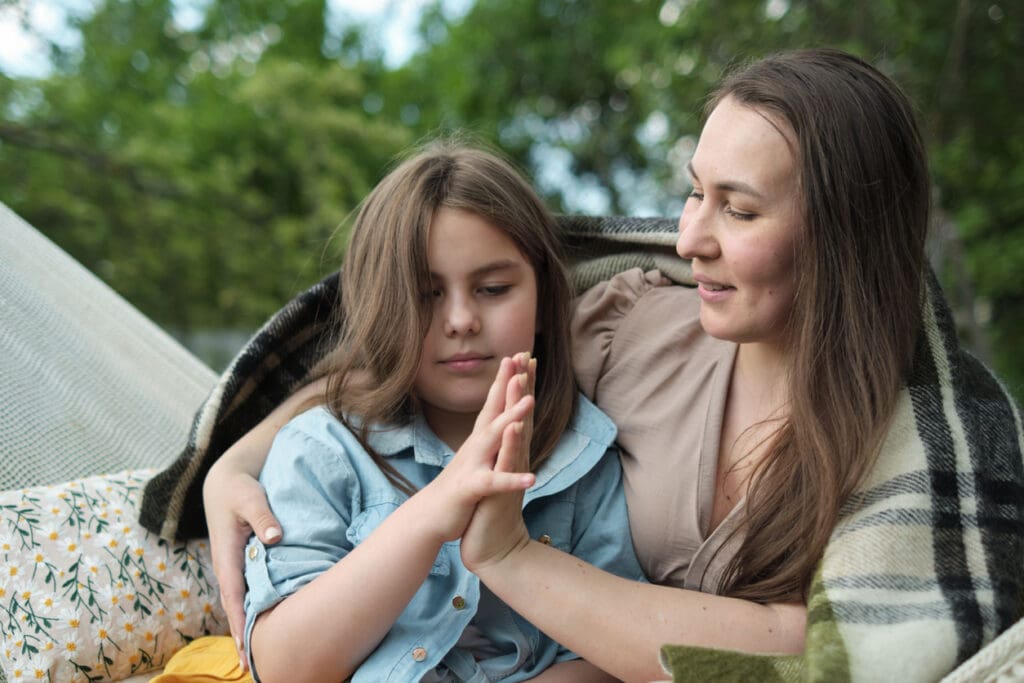
What’s missing? The now fourth-year PhD candidate at the University of California Davis thinks the answer lies in something researchers have suspected but rarely tested: having parents and children practice together. Guan’s Mind & Life-funded research project on parent-child mindfulness takes a novel approach—targeting the family unit, not just the child. The premise: intervening with both generations simultaneously, before stress patterns solidify, might offer a pathway to well-being that isolated school-based programs have missed.
Guan’s journey in contemplative science began as an undergraduate at the University of California Santa Barbara, where she took a mindfulness class taught from a cognitive psychology perspective. The course introduced her to concepts like meta-awareness and mind wandering, seeds that took root after graduation when Guan spent three years working with stress researcher Elissa Epel at the University of California San Francisco’s Aging, Metabolism and Emotion Center. There, Guan helped run digital mindfulness trials, worked on micro-randomized interventions for women with early life adversity, and explored different contemplative practices.
Throughout this work, Guan kept arriving at the idea that by the time these individuals reached her studies, stress patterns had already taken root. That realization, combined with her background in applied psychology and education, led her to developmental psychology and a crucial insight: parents’ stress and children’s well-being are deeply interconnected. The U.S. Surgeon General’s 2024 report on parents’ mental health underscored what research has long shown—stress doesn’t stay contained within one family member. It spills over, affecting everyone in the household.
With funding from a Mind & Life’s Francisco J. Varela Grant, Guan is now launching an innovative study that challenges conventional approaches to teaching mindfulness to young people. Rather than targeting children alone, her research will examine whether families practicing together produce stronger benefits for both generations.
The concept hinges on what developmental psychologists call “co-regulation”—the dynamic way parents and children influence each other’s emotional states and behaviors. “Parents set an example for children, and children almost serve as a reminder to their parents,” Guan explains. “They learn from each other, and they’re keeping each other accountable.”
“Parents set an example for children, and children almost serve as a reminder
to their parents. They learn from each other, and they’re
keeping each other accountable.”
The large-scale MYRIAD Trial, which tested school-based mindfulness with thousands of adolescents, found disappointingly limited benefits. Guan believes she knows why: in schools, the ratio of trusted adults to children is too large for the intimate, modeling relationship that can help contemplative practices stick.
Guan’s study will recruit 400 parent-child pairs across California, with children aged 13-17. Families will be randomized into one of four conditions: child-only mindfulness practice, parent-only practice, parent-child joint practice, and a waitlist control condition. The mindfulness practice groups will use the same digital platform—the Headspace app—making this one of the first large-scale studies to examine whether practicing together, rather than the meditation content itself, makes a difference.
The eight-week structure is adapted from successful adult trials Guan worked on with Epel’s team. Families begin with Headspace’s “Learning the Basics” pack—30 days of foundational mindfulness training covering breathing awareness and present-moment attention. They then progress to the “Letting Go of Stress” pack for the remaining weeks, directly targeting the elevated stress that qualified parents for the study in the first place. Throughout, families complete questionnaires measuring not just individual stress and emotional regulation, but also relationship quality between parent and child.
Unlike school-based programs that dilute the adult-to-child ratio, Guan’s design leverages the parent-child dyad itself—the most intimate modeling relationship in a young person’s life. Unlike many mindfulness trials that recruit broadly, she’s specifically targeting high-stress families who stand to benefit most. To qualify, parents must meet criteria for elevated stress, often associated with demanding work environments, financial insecurity, experiences of marginalization, and their own histories of early adversity. And unlike interventions that end at eight weeks, Guan plans to follow families for up to a year, tracking whether the joint practice creates lasting habits. Headspace has agreed to provide families premium access for the full year, generating usage data that will reveal whether families continue practicing after the formal study ends.
The study also addresses a persistent challenge in mindfulness research: how do you reach families who lack time or resources for in-person retreats? By recruiting through rural clinics and targeting parents with long working hours, Guan’s digital approach makes participation possible for families typically excluded from contemplative interventions. “We’re thinking thoughtfully about targeted recruitment,” she explains. “Who’s really excited to try this out? Who thinks they really need it?” This selective approach aligns with research showing that mindfulness interventions for youth in particular work better when people choose to participate, rather than when they’re universally assigned.
The digital format isn’t without its critics. Some contemplative science researchers have raised important questions about giving screen-based interventions to young people during a time of growing concern about digital media’s effects on youth mental health. But Guan sees the digital platform as opening doors for families who need it most.
“We’re really trying to reach children and families who typically don’t have resources to go to a physical meditation retreat or to a community meditation group,” she says. “To really leverage the digital component.”
“We’re really trying to reach children and families who typically
either don’t have resources to go to a physical meditation retreat,
or go to a community meditation group. To really leverage the digital component.”
While Guan’s primary focus is on stress reduction and emotional regulation, she’s also measuring something more nuanced: whether parent-child mindfulness practice improves relationship quality itself. “You feed two birds with one scone,” she says, using a more compassionate version of the old saying. “You get the individual level benefits and also a larger level of relationship improvement.”
If her hypothesis holds true, that involving parents will enhance effectiveness for both children and parents, the implications could reshape how we think about family-based mindfulness interventions. “There are so many different flavors of mindfulness interventions now, and we’re seeing mixed findings,” Guan observes. Finding that practicing mindfulness together benefits relationships as well as individual well-being could motivate people to implement these practices across different settings, she hopes.
The study, which launched earlier this year, is an attempt to understand whether the bonds we share with those we love can amplify the benefits of contemplative practice. For families navigating mounting stress, research showing that parent-child mindfulness interventions strengthen both individual well-being and relationships could offer a crucial pathway forward—one that intervenes not after patterns have solidified, but as they’re still forming.
As an attendee at the 2022 Mind & Life Summer Research Institute, Guan remembers the sense of hope that emerged from listening to contemplative science leaders discuss their work during challenging times. She’s eager to return to the Summer Research Institute once initial findings emerge—bringing the work back to the community that supported its inception. And perhaps, helping answer that persistent question: what happens when we intervene earlier, together?