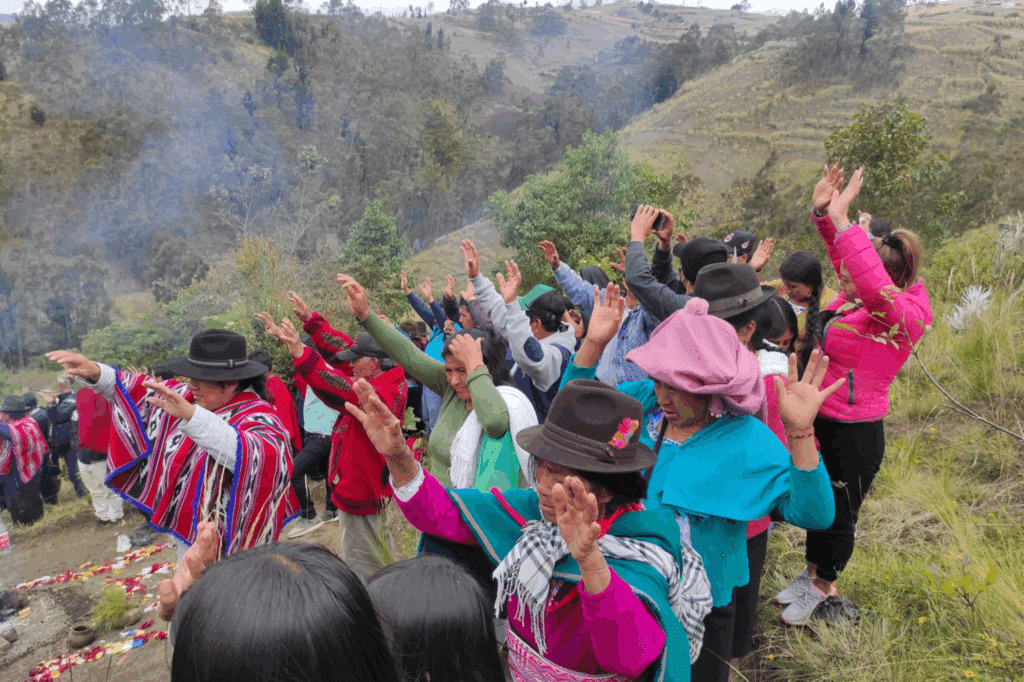
Ask a farmer in the Ecuadorian Andes how they know if the soil is healthy, and they might tell you they can feel it. Press further, and you may not get a rational explanation. You’ll likely hear about the humidity visible in the earth, the number of worms beneath the surface, and the smell of the dirt. These aren’t just sensory observations, they’re expressions of a way of knowing the world that Western science is only beginning to understand.
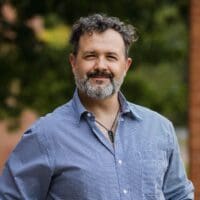
“There are many ways of understanding things that are not just rational,” says Amaya Carrasco-Torrontegui, a researcher at the University of Vermont’s Institute for Agroecology. Together with her husband and research partner Carlos Andres Gallegos-Riofrío, she has spent years working alongside Indigenous communities in the Andes—a partnership grounded in what Gallegos-Riofrío describes as “the same passion and vocation for the planet and people.” They both attended the Mind & Life Institute’s online 2021 Summer Research Institute (SRI), “The Mind, the Human-Earth Connection, and the Climate Crisis,” which helped crystallize how their community-based work connects with contemplative science.
“It was very inspirational,” says Carrasco-Torrontegui of the SRI experience, “because then I realized that many things that I thought were interesting to me, personally, were possible to connect with my profession, doing science.” Now, with support from a Mind & Life Varela Grant, they’re bridging Indigenous Andean wisdom with contemplative research—exploring how traditional agroecological spaces influence mindfulness, well-being, and mental health among Kichwa communities in Ecuador’s central highlands, particularly in the face of displacement and urban migration.
The Act Gives Meaning to the Word
In Western culture, Gallegos-Riofrío underscores, knowledge often lives in the realm of explanation—through rationalization, theorization, and conceptualization. But in Andean traditions, understanding comes through sentipensar—a Spanish term meaning to feel-think-act. It’s not enough to describe something; the doing itself creates meaning.
While in Western culture, rational thought tends to be prioritized, many Indigenous people in Latin America embrace more embodied, intuitive ways of knowing and learning from experience, explains Carrasco-Torrontegui. “You have to do things to teach people to really understand.”
Gallegos-Riofrío offers an example from the Kichwa language: “I can say, ‘I love you,’ but then be a nasty person with that person. In Kichwa, I say ‘I love you,’ but then I have to behave in a way that’s consistent. The act is the one that is giving meaning to the word.”
“The act is the one that is giving meaning to the word.”
This isn’t mere philosophy—it has shaped law and policy. Ecuador became the first country in the world to constitutionally recognize the Rights of Nature, followed by Bolivia. Both nations drew directly from Indigenous wisdom about reciprocal relationships with the Earth. “If you follow these types of principles,” says Carrasco-Torrontegui, “you can have a sustainable agroecosystem that produces food for many, many years—that is not polluted, that is healthy, that feeds your kids, that you have healthy animals, healthy water. Everything is in balance.”
Pacharuna: A State of Consciousness
Central to their research is the concept of pacharuna. In Kichwa, pacha can mean many things—the landscape, Mother Earth, the universe, even time. Runa means human. Together, pacharuna describes a human walking in the awareness that they are one with the Earth.
“It’s a state of consciousness,” Gallegos-Riofrío explains. “It comes hand-in-hand with ecocentric perspectives. You see integrated humans living with the land and animals,” adds Carrasco-Torrontegui.
When we think of contemplative practice, we might picture someone meditating alone in silence, eyes closed, perhaps in a temple or yoga studio. But Carrasco-Torrontegui offers a different image: pacharuna describes a person that is embedded in Earth, in mountains, around plants, animals, insects. They are in a different state of well-being that is interconnected. “There is a moment when you do contemplative practices that you realize the connection with the whole. But we think you can achieve the same state when you are embedded profoundly with the landscape and the place where you grew up, or where you live.”
“There is a moment when you do contemplative practices
that you realize the connection with the whole. But we think you can achieve
the same state when you are embedded profoundly with the landscape
and the place where you grew up, or where you live.”
This perspective challenges the individualistic framing that sometimes accompanies wellness culture. For Andeans, Gallegos-Riofrío notes, “it is totally inconceivable to be well if people around you are not well.” Contemplative research, rooted in traditions like Buddhism, Indigenous traditions, and other spiritual and philosophical systems, has long recognized this truth—that practices like meditation and compassion training foster an interconnected worldview, creating ripples of impact from the personal to the planetary. Carrasco-Torrontegui and Gallegos-Riofrío’s research centers not on yoga studios or mindfulness centers, but on rural, historically marginalized communities where this interconnection is lived daily.
The Project: Measuring Connection
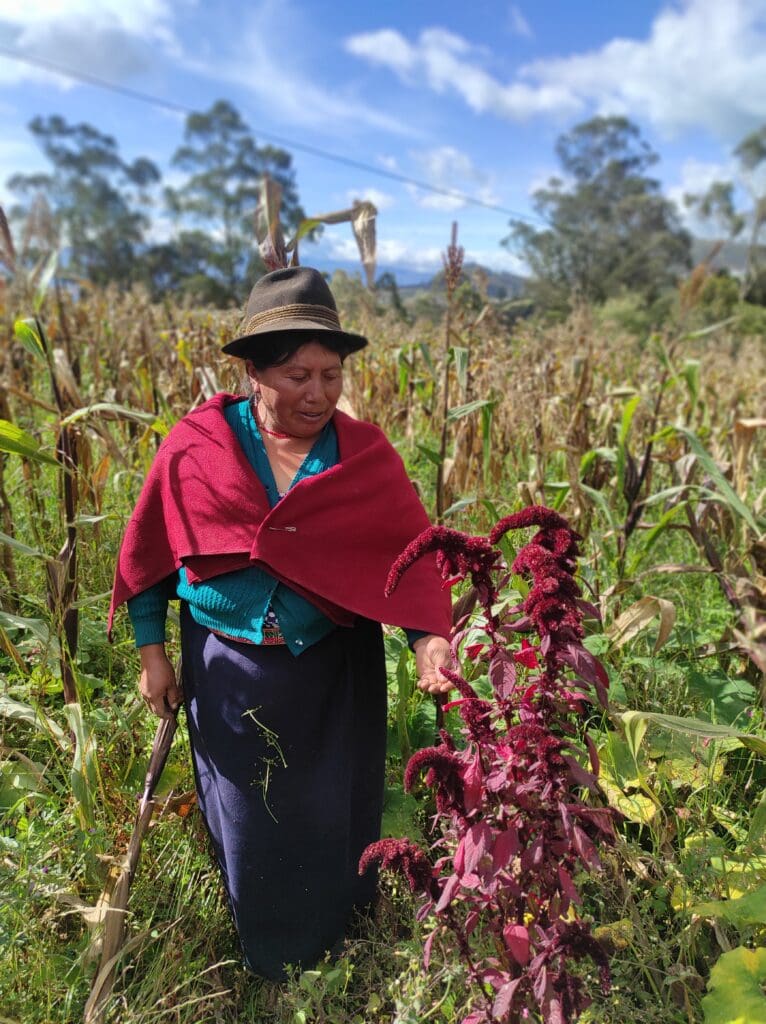
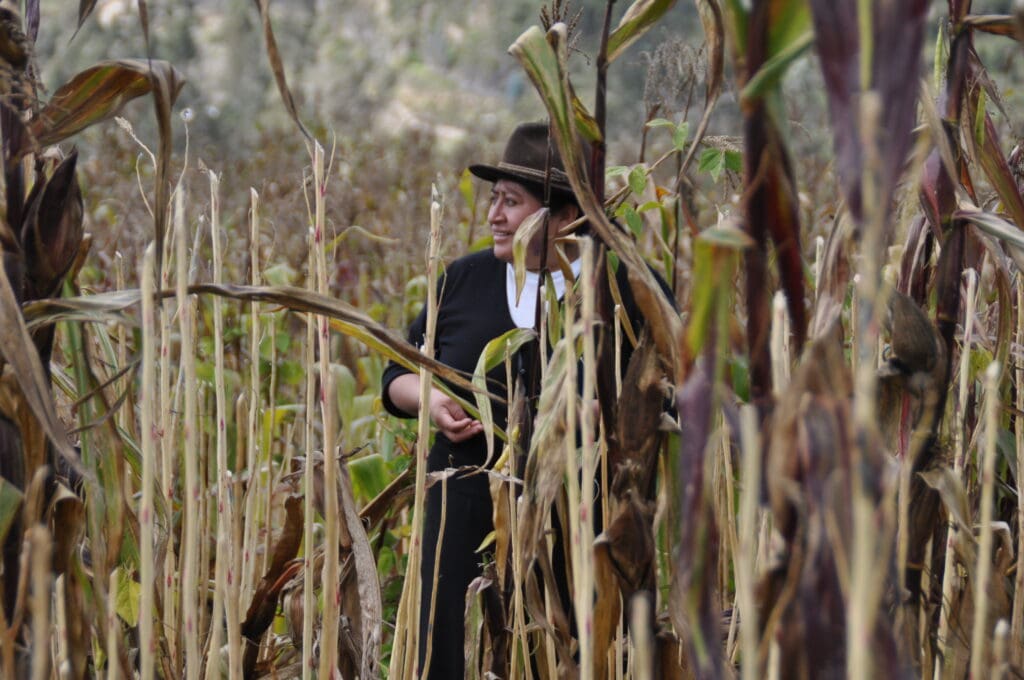
The study, currently underway, examines 54 Kichwa participants from three different contexts: those living in traditional agroecological communities, those who have shifted to industrial farming methods, and those who have migrated to the city.
In the agroecological setting, the physical environment is pretty diverse, balanced, and usually has healthy soils because people are working and bringing fertility to the soil. They live in community, and there are many generations of people living in the same space. The industrial farming condition involves agrochemicals and monocultures oriented towards producing for the market. And the urban condition involves Indigenous people who have left their communities for city life.
To measure something as complex as the pacharuna state, Carrasco-Torrontegui and Gallegos-Riofrío are using a mixed-methods approach that reflects their commitment to culturally grounded research. Cardiac coherence technology—which measures heart rate variability to assess shifts in the parasympathetic nervous system, the body’s rest-and-restore response—is measured at three points during each session. “It helps to see how your nervous system is working,” Carrasco-Torrontegui explains. A coherent state reflects alignment among physical, cognitive, and emotional systems, often associated with positive emotions like appreciation, compassion, and connection.
Alongside these physiological measurements, in-depth interviews explore participants’ relationships to the land, while a follow-up survey uses instruments specifically validated for Andean populations—including measures of depression, nature integration, and perceived wellbeing. Together, these methods allow the researchers to examine patterns across the three living contexts: how do people embedded in traditional agroecological spaces respond differently from those disconnected through urbanization or industrial agriculture?
“The core question,” Gallegos-Riofrío reflects, “is what can the rest of the world learn from this level of coherence and integration—psychologically, biologically, and spiritually?”
Bringing Ancestral Wisdom to a Global Conversation
Carrasco-Torrontegui and Gallegos-Riofrío see themselves as messengers between worlds, working to elevate Indigenous perspectives that have been historically overlooked or erased. “My hope is to bring awareness to people that live in different places of the world, of these very meaningful and ancestral ways of living,” says Carrasco-Torrontegui.
She’s also keen to address a gap she sees between contemplative research and public perception: “There is this idea of people engaging in contemplative practices just thinking about themselves, that can be very individualistic. How can you connect this with the challenges we face worldwide—climate change, the disappearance of species, and pollution? How can these ways of living inform a healthier way of connecting with the Earth?”
“How can these types of ways of living inform a
healthier way of connecting with the Earth?”
For Gallegos-Riofrío, elevating this dialogue from isolated rural communities into global conversation creates ripple effects back home, too. Sometimes in very subtle ways, he says, like bringing self-esteem and pride to communities whose knowledge has been marginalized.
“It is not just about species disappearing,” he says, “People disappearing with their cultures is a tragedy, too, and those cultures have a wealth of knowledge to face contemporary challenges.”
The two describe this pilot study as a first step toward larger investigations that could strengthen the evidence base for nature-health connections while honoring Indigenous ways of knowing. Beyond peer-reviewed research, they aim to produce a methodological toolbox that could serve as a model for culturally relevant nature-health studies in other Indigenous communities.
Carrasco-Torrontegui and Gallegos-Riofrío find hope in recognizing that “ancient Eastern and Western traditions are starting to connect because there are similar premises that we can use to work together.” The path forward lies not in choosing between scientific measurement and embodied wisdom, but in weaving both together—in awareness that we are one with the Earth.